

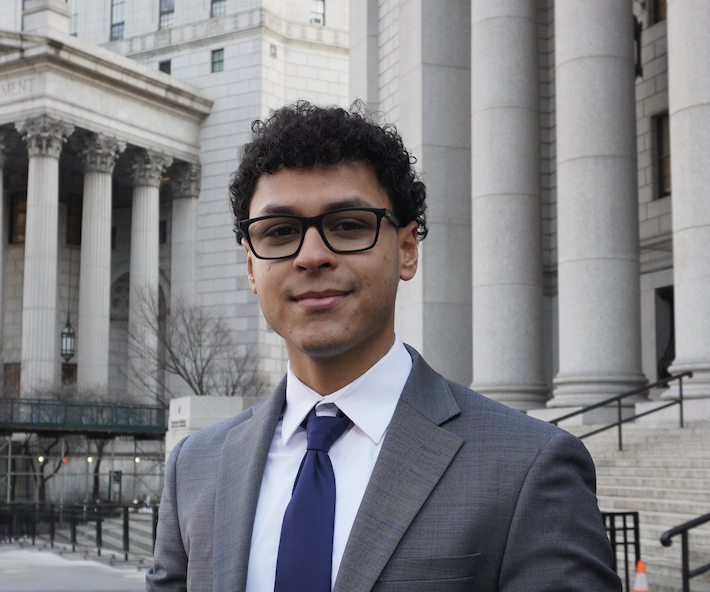
Baruch College sophomore Dylan Torres won the first Policy, Ethics, Law, Technology and Artificial Intelligence Publication Prize for an essay on how AI harms the environment.
Torres is a Macaulay Honors student majoring in finance with a minor in business law. He is also a member of the Pre-Law Society.
Torres was one of six winners and one of only two undergraduate students to win. Baruch announced the winners in August, and each student received $250.
The prize is part of PELTA, a new Baruch program that studies how AI affects society. The winning work is featured on the PELTA website.
PELTA launched in March at the Ethical A.I.ms symposium, where competitors looked at the legal, ethical and social side of AI.
Torres’ winning essay was titled “Looking at AI Ethically Through an Environmental Lens,” and looks at how much water, land and energy AI uses.
His interest in the topic started in high school when Torres was the president of the environmental club.
At Baruch he took a course with Professor Valerie Watnick. She taught him about sustainability in farming and fashion and Torres wanted to apply those lessons to AI.
“With AI increasing, so is the environmental effects of it,” Torres told The Ticker.
Professor Yafit Lev-Aretz encouraged him to apply for the prize. Torres had worked with her through a fellowship program. While researching, Torres was shocked by how the big data centers, buildings full of computers that run AI, are.
Since writing the essay he has learned more and found that companies often build data centers in lower-income areas.
“They don’t really care about the environment that they’re affecting around them,” Torres said.
Torres also made a short video for the prize. It featured people using AI to make pictures and at the end, they had no water left.
Torres said the video speaks to people who think the problem will never reach them. “At the end of the day, it will eventually affect you, and when it does, it’ll be too late to change anything, or too late to care,” he said.
Torres said students should think before every prompt, “Is it really necessary? Is this something that I need to use AI for?” he said. “Is this something that I can find out in another way?”
He suggested that students try books and other resources first. AI should not be the first choice just because it is easily accessible.
Torres noticed that more professors now use AI in class. He said that is not always a bad thing, but he believes each professor should decide if AI is truly needed to learn. He also sees a bigger problem. The country does not have enough water, land and energy to support all the data centers being built.
“AI is a tool that’s here to stay,” Torres said. “I don’t see it going anywhere.”
That is why he believes the government must step in. Policymakers need to find new energy sources before AI spreads further.
Torres plans to keep studying the issue. This semester he is taking LAW 3250: Financial Regulation of Emerging Technologies. The course covers how the government regulates new financial tools like prediction markets.
He hopes it will teach him how to regulate AI too.