
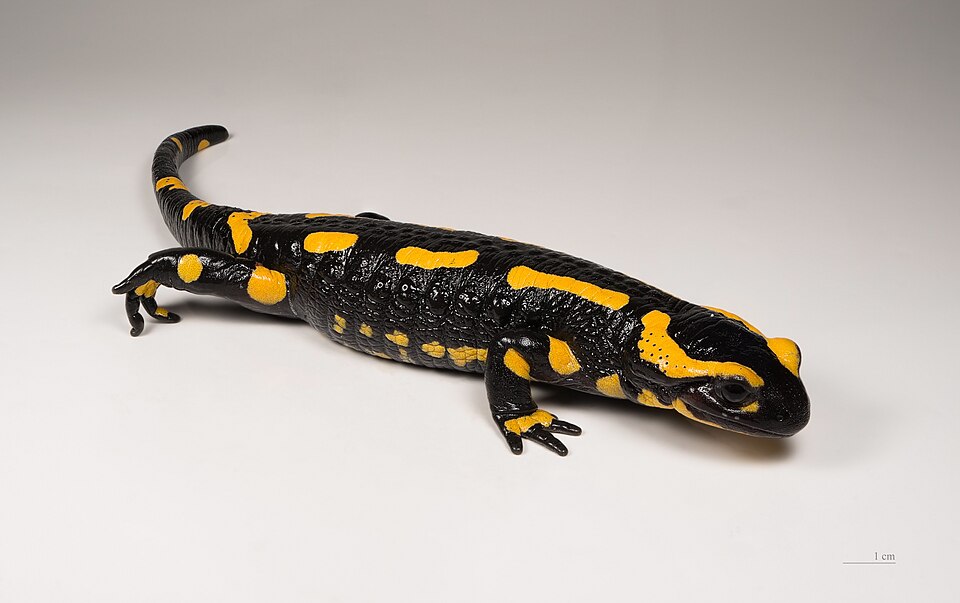
Fire salamanders are known for their distinctive black-and-yellow markings and toxic skin secretions, which help protect them from predators.
However, researchers have discovered another unusual feature hidden in their biology: under ultraviolet light, these amphibians produce a bright green and cyan glow.
The discovery offers new insight into a familiar species and raises questions about whether fluorescence plays a role in communication or defense.
The research team, which included scientists from the Max Planck Institute for Chemical Ecology, examined the European fire salamander. Researchers found that the fluorescence was most noticeable along the animals’ yellow markings, particularly on their undersides and sides.
They traced the phenomenon primarily to glands in the salamanders’ skin and the substances released by those glands. Surprisingly, these secretions continued to fluoresce for more than 24 hours after being released.
The glow results from a process called biofluorescence. Certain compounds in an organism absorb UV light and reemit the energy as visible light, producing the green and cyan appearance observed in the salamanders.
This process differs from bioluminescence, in which organisms generate their own light through chemical reactions.
For example, fireflies produce light through bioluminescence, while fire salamanders require an external source of UV illumination to fluoresce.
Although biofluorescence has been documented in marine organisms, scientists have increasingly identified the phenomenon in terrestrial animals, including reptiles, birds and amphibians. The discovery is particularly surprising because fire salamanders have been studied extensively.
“It is fascinating that such a well-studied species still harbors unknown phenomena like this,” Bernat Burriel, the study’s first author, said. He explained that the finding demonstrates how familiar organisms can possess characteristics that remain undiscovered until scientists examine them using new techniques.
Researchers are now investigating why fire salamanders fluoresce. One possibility is that the glow helps individuals recognize one another, particularly in dark or densely vegetated environments.
Because salamanders are active at night, their fluorescence could make their yellow markings more visible under certain natural lighting conditions.
Another possibility is that fluorescence strengthens their existing warning signals. Fire salamanders use their black-and-yellow coloration to advertise their toxicity to predators, a defensive strategy known as aposematism.
Their skin produces toxic compounds called samandarines, which discourage predators from attacking. Fluorescence could make these warning markings even more noticeable.
Martin Kaltenpoth, a co-author of the study, explained that fluorescence could help salamanders detect one another or serve as an additional defensive signal. However, these explanations remain hypotheses, and researchers have not yet established the glow’s biological purpose.
Another major unanswered question concerns the chemical responsible for the fluorescence. Scientists have not identified the specific compound, although evidence suggests it may be a molecule previously unknown in this species. Identifying it could help explain how the glow develops and what function it serves.
The study highlights how much remains unknown about animal biology. Further research could reveal whether this hidden glow contributes to salamander communication, survival or reproduction.