
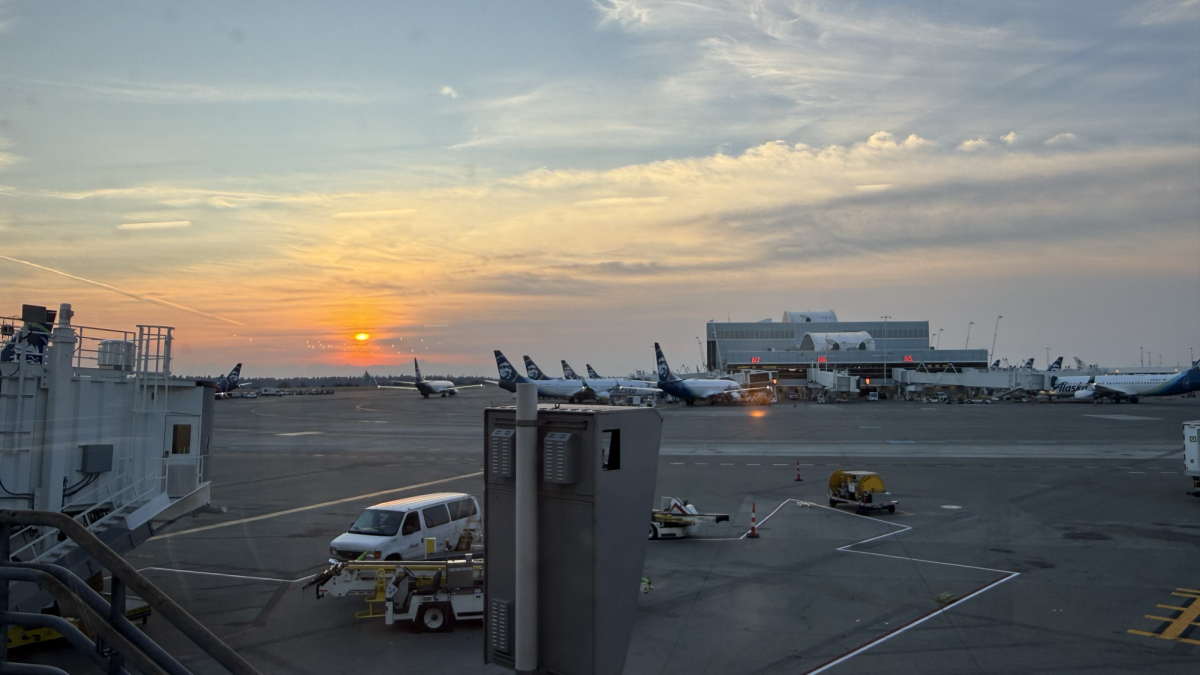
The Federal Aviation Administration issued a ground stop order on Nov. 13, halting all air travel across the U.S., citing, “extraordinary circumstances” and “for reasons of safety.”
The ground stop was issued out of an abundance of caution following a telecommunications failure that disrupted several radar feeds and weakened communication across nationwide air traffic control centers.
The FAA attributed the failure to legacy equipment that quickly became unstable when data began to flood the FAA FTI network at a rate of 1,000 connection attempts every four to five seconds, disrupting the system and creating the initial instability.
In response to the ground stop, airlines and aviation logistics experts provided travelers with a map of potential delays caused by the system outage, which are anticipated to persist in the coming days.
American Airlines addressed the ground stop to AA Newsroom, detailing potential service disruptions, stating, “American Airlines is focused on operating as many remaining flights as possible this evening while positioning the airline for the strongest possible recovery tomorrow and in the days ahead.”
“For the remainder of the evening, we are prioritizing flights to non-hub cities, as well as international flying, to position aircraft and crew where they are needed to help restore our operation. We expect residual delays and cancellations tonight and into tomorrow following the FAA’s nationwide ground stop. We’re grateful to our team members for their continued work to care for our customers and minimize the impact of this disruption as much as possible,” the airline continued.
Following the ground stop, over 12,400 flights were promptly cancelled, displacing approximately 1.5 million travelers in airports across the U.S.
The ground stop prompted travelers to turn to alternative ways of travel, such as trains, cars or cruises.
Passengers and longtime friends Ann Bruns and Janice Simpson opted to hire a driver to transport them six hours away from Atlanta to Florida following their flight’s cancellation. They detailed their frustration, as their luggage had already boarded the plane headed towards Florida.
“We’re about to go on a cruise ship with no clothes,” Simpson told The New York Times in an interview.
The downpour of travelers into other means of transportation caused outages of their own. Amtrak experienced major ticketing delays and major service disruptions as they attempted to handle the influx of riders.
Subsequent to the service disruptions and ticketing delays, Amtrak released a series of statements, reassuring riders that service would proceed as usual and to reattempt both purchasing tickets and accessing the app and site in a couple of minutes due to the large volume of traffic.
The outage comes with a recent trend of system outages throughout America; merely a day prior on Nov. 12, Microsoft experienced a widespread system outage impacting services Microsoft Outlook, Exchange Online, Microsoft Teams, Microsoft Copilot 365, Microsoft Defender XDR and many more.
In the days following the ground stop, eight major American banks, JPMorgan Chase, Bank of America, Wells Fargo, U.S. Bank, Capital One, Truist Bank, PNC Bank, Citibank and the currency exchange site, Zelle, experienced similar outages, primarily with users accessing their online banking accounts.
Tech giant Apple suffered similar service and corporate outages within its system just a day later, impacting Apple Pay, iCloud and Apple Support.
Currently, the threat of cyberattack in these instances has largely been ruled out; however, many across the nation continue to express concern and uncertainty following the thread of tech outages.
The ground stop lasted just under 4.5 hours, with flights across the nation gradually restoring to semi-regular scheduling, finally offering travelers a semblance of optimism as plans continue to taxi and take off on the runway.