
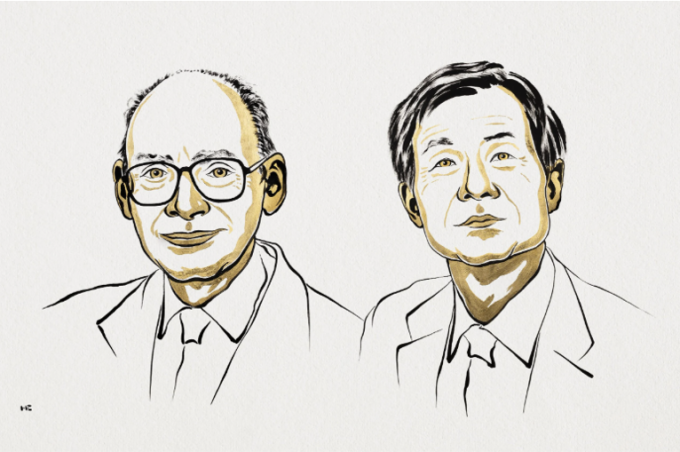
Henri Kagan of France and Kenso Soai of Japan were awarded the Nobel Prize in Chemistry on Oct. 7, due to their exploration of “mirror image molecules,” like a left and right hand. Mirror image molecules are molecules that reflect each other, a trait that is important for industries such as pharmaceuticals and agriculture.
The significance of this finding is defined through its contribution to the ever-expanding medical world, in which new molecule data is always in demand to refine certain medications. For instance, the finding of mirror image molecules can assist greatly in the creation of ideal medicine that will limit side effects and prevent deaths.
These goals are important because of the immense birth defects in many babies due to a morning sickness medicine prescribed to mothers called thalidomide.
Biologically, the human body has certain enzymes and proteins that react differently to “left-handed,” molecules, meaning that many drug molecules may have to mirror the enzymes and proteins to combat disease.
Additionally, some mirror image molecules are often ignored by the immune system and are allowed to persist through and stay longer in the stomach and the bloodstream, extending their effects.
As for the findings of Soai, he discovered a methodology to create an asymmetric autocatalytic process in which they could stimulate the creation of more mirror image molecules through the method of duplicating itself.
Through intensive experimentation, Soai found a substance that could create itself with the assistance of other chemicals: 5-pyrimidyl alkanol.
This compound was crucial in his publication from 1995, as it described starting with a small excess of one enantiomer and ending with an excess of 87%, showing a strong result of a major enantiomer.
For the findings of Kagan, he saw a sharpening of asymmetry in mirror image molecules. He began with the goal of finding enantiomers that were as pure as possible, hoping to use it for pharmaceutical advancement.
To drive asymmetric reactions, he utilized catalysts with one component of a metal that acts as a driving force, and another component of a chiral [handed] substance.
This process would raise confidence in the reaction being fully asymmetric.
Kagan’s experiment had differed from those previous as others tested upon the assumption that to obtain a pure enantiomer, you must use one as pure as possible in the experiment; however, Kagan opposed this ideal.
In his experiment, he used a handed catalyst and found it led to a handed product through asymmetric amplification, where a small imbalance in the catalyst creates a larger imbalance in the final product.
His results revealed that the relationship was not linear and was instead curved, showing that the slowest chemical reactions were created by left-right molecules rather than left-left or right-right.
Through Kagan’s experimentation, he created a major scientific breakthrough in chemistry, disputing common thought that the relationship between handed catalysts and products was linear.
He discovered that it was instead curved, meaning that the product’s enantiomeric excess displayed asymmetric amplification, leading to the theory that a small initial imbalance can lead to a large final imbalance.
Hand in hand, they fit together two different aspects of the larger puzzle to refine the idea surrounding molecular handedness.
While Kagan demonstrated how small imbalances in the catalyst can amplify the resulting product, Soai revealed through expanding Kagan’s work that those small initial imbalances in the autocatalytic process can lead to greater imbalance in the resulting product.
With this breakthrough, they were awarded the Nobel Prize, a prize awarded to those who make a groundbreaking contribution in respect to chemistry.