
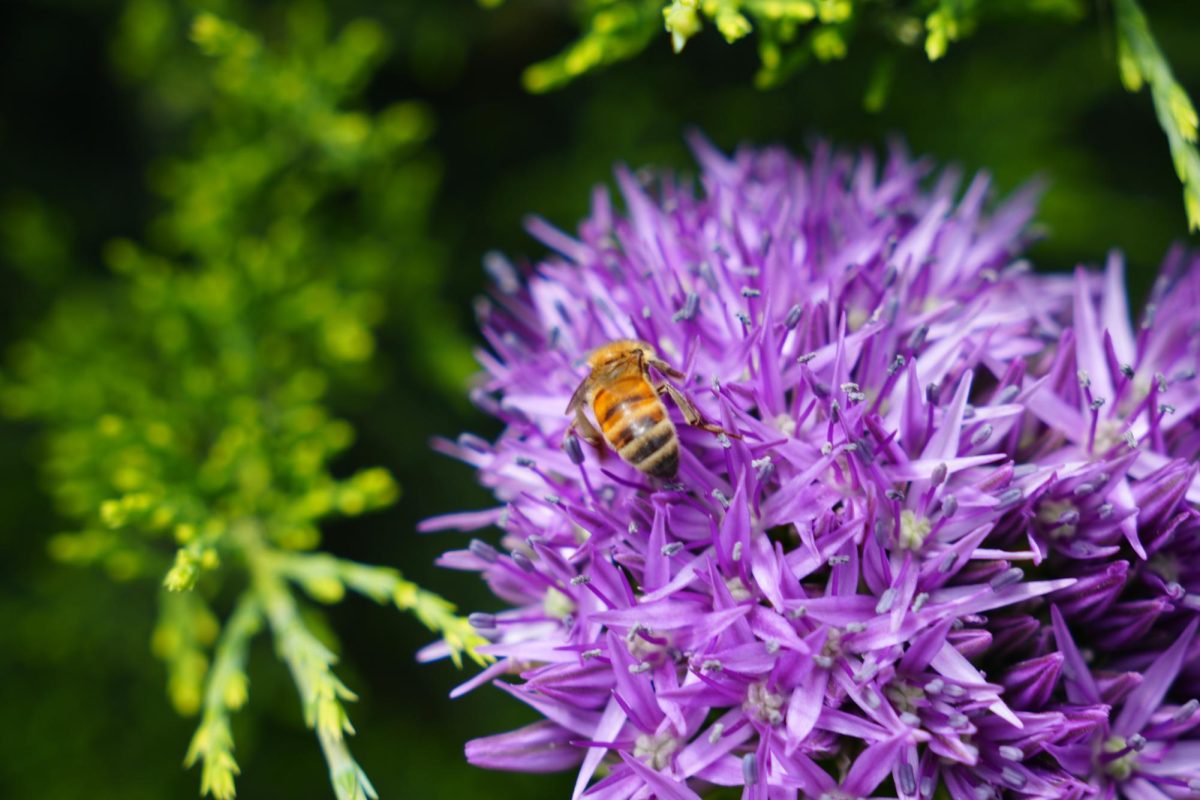
Honey bees are often celebrated for their role in pollination and honey production, but new research suggests they may also be putting other pollinators at a disadvantage.
A study from Anglia Ruskin University in the U.K. found that honey bees frequently chase away competing insects from flowers, limiting access to essential food sources.
Researchers warned that rising temperatures might make this competition more intense and threaten wild pollinator populations.
The study followed pollinator activity over two years at five locations in and around Cambridge, England.
Researchers focused on bramble and ivy, two flowering plants that attract numerous insects and provide important sources of nectar and pollen. Each location was situated within 300 meters of an established honey bee colony.
Over 93 hours of observation, the research team documented interactions among five groups of flower visitors: honey bees, bumblebees, solitary bees, hoverflies and other insects, including butterflies, beetles and wasps.
They recorded instances in which one insect interrupted another’s feeding or prevented it from accessing a flower. Interactions were classified as wins, losses or shared access depending on which insects successfully obtained food.
The results showed that honey bees frequently dominated these encounters. Researchers found that other pollinators avoided honey bees in 28% of observed interactions on bramble and 36% on ivy. In at least 20% of encounters won by honey bees, they physically pushed aside or chased away competing insects.
The researchers also discovered that higher concentrations of honey bees were associated with fewer wild pollinators.
On bramble flowers, doubling honey bee density corresponded with a 14% decrease in bumblebee abundance. On ivy, higher honey bee numbers were linked to reduced populations of solitary bees and hoverflies.
One unexpected exception was the ivy bee, a solitary bee species that actively challenged honey bees and sometimes successfully defended its access to flowers.
It was the only other pollinator observed regularly initiating aggressive encounters against honey bees.
Lead researcher Victoria Buckle, a PhD student at Anglia Ruskin University, emphasized that the research was intended to support conservation rather than discourage beekeeping.
“The aim of our study was not to discourage beekeeping, but to better understand how competition happens between wild and managed pollinator species,” she explained.
Climate change could make the situation worse. Researchers observed that competitive encounters became more frequent during warmer conditions.
Higher temperatures can cause plants to produce less nectar, leaving fewer resources available to pollinators. Additionally, honey bees generally become more active as temperatures rise, while bumblebees and hoverflies are more sensitive to heat.
Buckle warned that “future predicted warming in the U.K. is only likely to further exacerbate interference competition from dominant honey bees.”
The researchers suggest that managing the density and placement of honey bee colonies may help wild and managed pollinators coexist, particularly in urban areas where beehives are increasingly common.
The study highlights the importance of considering competition when developing pollinator conservation strategies.
Although honey bees remain valuable pollinators, protecting wild species requires ensuring they have sufficient access to the flowers and resources they need to survive.