
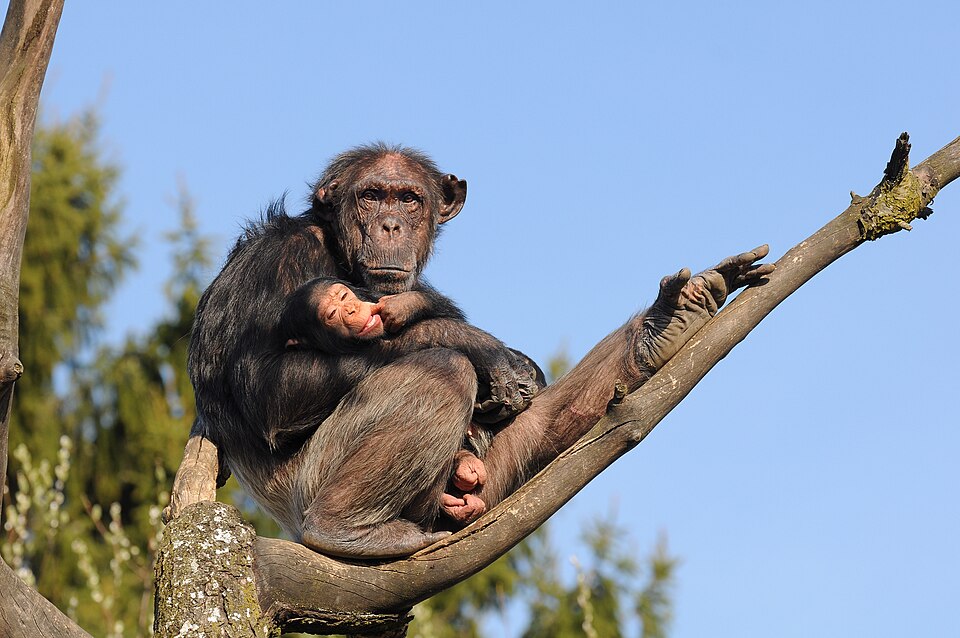
Scientists studying chimpanzees in Africa honed in on how young voice develops.
Their findings indicate that the calls of baby chimps are influenced by where they live in a manner similar to developing a regional accent. “While research in recent decades has shown chimpanzees show population-specific vocal signatures, debates regarding the sources of this variation, namely whether it results from social, genetic, or ecological factors, continue,” Kassandra Giragosian, the study’s lead author and a doctoral researcher at Queen Mary University of London, said. Giragosian and her colleagues studied chimps at two locations: Chimfunshi Wildlife Orphanage in Zambia and Gombe National Park in Tanzania. The team analyzed over 11,000 calls from 30 young chimpanzees and found a link between their surroundings and how their calls developed.
The researchers recorded infants up to four years old and juvenile ages 4 to 10 using directional microphones. In most cases, they picked a chimp at random and recorded it in five minutes. Dense foliage and expansive enclosures made recording hard, so Giragosian and her team employed supplemental data collection methods to collect enough calls. “By examining vocal development through an ontogenetic lens, the study provides a valuable framework for investigating how communication systems emerge and diversify within animal populations,” Giragosian added.
The study focused on grunts, whimpers and laughs because they are common in the infant and juvenile chimpanzee population. To prevent the sound distortion at the beginning and end of recordings from influencing the data, a Hanning window function was applied to each call to smooth out its sounds. The calls were separated by spectral and temporal variables as both are distinct factors in influencing the call of a chimp.
After the data was cleaned up, a statistical test was performed to determine if the vocal signature of each chimpanzee could be differentiated between the two populations. Despite the projected accuracy rating of around 60%, the analysis was highly accurate in predicting which chimpanzee population a vocalization type such as laughs, grunts and whimpers, originated from.
The results showed 97.62% accuracy in predicting whimpers, 96.83% accuracy in predicting laughs and 89.67% accuracy in predicting grunts. “Our findings show that chimpanzee vocalizations are not simply fixed from birth but continue to develop as young animals interact with their social and ecological environments,” Giragosian said. While genetic differences can still play a role, the study challenges previously held notions that primate communication is rigid. The evidence sheds light on how location can impact the development of a chimpanzee’s unique vocal behaviors. “By showing that population-specific vocal patterns emerge and become more pronounced during development, the research provides new insight into the biological and environmental factors that shape communication in primates and offers a fresh perspective on the evolution of complex communication systems,” Giragosian said.