
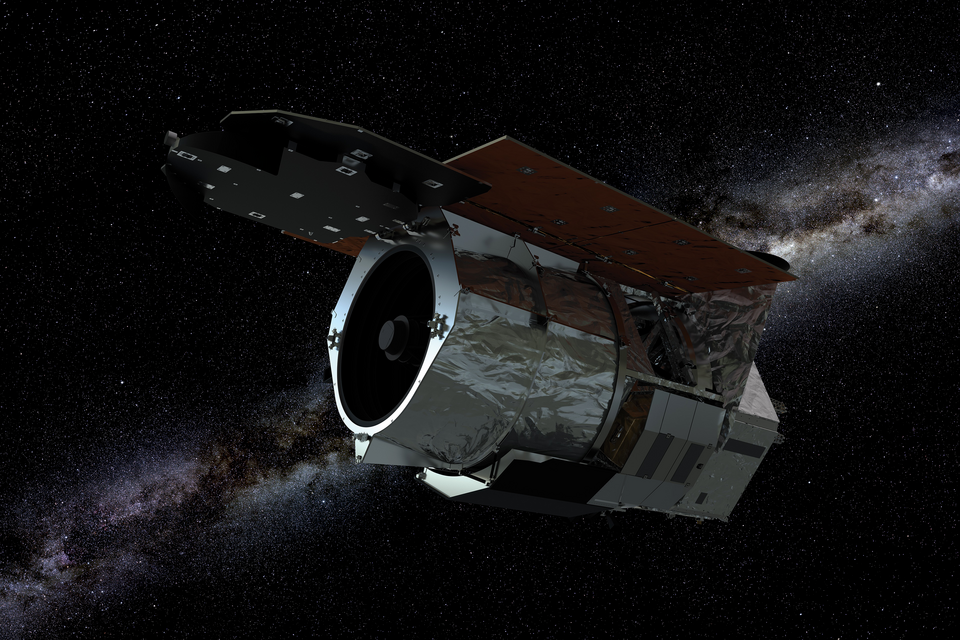
NASA’s Nancy Grace Roman Space Telescope launched on Aug. 30 aboard a SpaceX Falcon Heavy from Kennedy Space Center in Florida.
The telescope lifted off from Launch Complex 39A at the Space Center at 7:26 a.m. Eastern Daylight Time. Roman is spending three months traveling toward the Sun-Earth Lagrange Point 2, or L2, approximately 930,000 miles from Earth. According to the European Space Agency, the telescope is headed to investigate how the universe evolved, dark matter and dark energy.
Unlike the James Webb Space Telescope, which was designed to make detailed observations of small regions of the sky, Roman is built to analyze large areas quickly.
Additionally, Roman will be capable of measuring the universe about 1,000 times faster than the Hubble Space Telescope.
“It will combine Hubble-quality imaging with a field of view more than 200 times larger, allowing it to study billions of stars, millions of galaxies, thousands of exoplanets, and vast regions of previously unexplored space,” Bethan James, ESA’s Roman Project Scientist, said.
“This will enable astronomers to address some of the biggest open questions in astrophysics, from the nature of dark energy to the abundance of planets throughout our Milky Way galaxy,” she continued.
Roman will also search for exoplanets through gravitational microlensing, which uses the effect of gravity on light. When a foreground star passes in front of a more distant star from the telescope’s perspective, the foreground star’s gravity bends and magnifies the background star’s light.
If a planet is orbiting a foreground star, its gravity can cause a change in brightness detected by Roman.
Microlensing allows astronomers to find planets that can be difficult to detect through other techniques.
Reaching L2 is another important part of Roman’s mission. This location allows the telescope to have an unobstructed view of a large portion of the sky. Orbiting at L2 gives the telescope an unobstructed view while keeping it far away so the Earth is not in the way.
However, it requires a powerful launch vehicle. Falcon Heavy is equipped with 27 Merlin engines, which generate more than 5 million pounds of thrust during Roman’s launch.
Roman’s approach could possibly lead to discoveries that astronomers are not specifically searching for. Having a wide range of space in the sky, the telescope can reveal unusual galaxies, planetary systems or patterns that lay within the universe.
“Whenever astronomy opens a new window on the Universe, history has shown that some of the most important discoveries are the ones we never anticipated,” James said. “With its unprecedented combination of depth, area and image quality, Roman has every opportunity to surprise us.”
Roman is expected to conduct its mission for at least five years. Rather than replacing Webb or Hubble, Roman will complement their observations by giving astronomers a broader picture of the universe and how it has changed over time.