
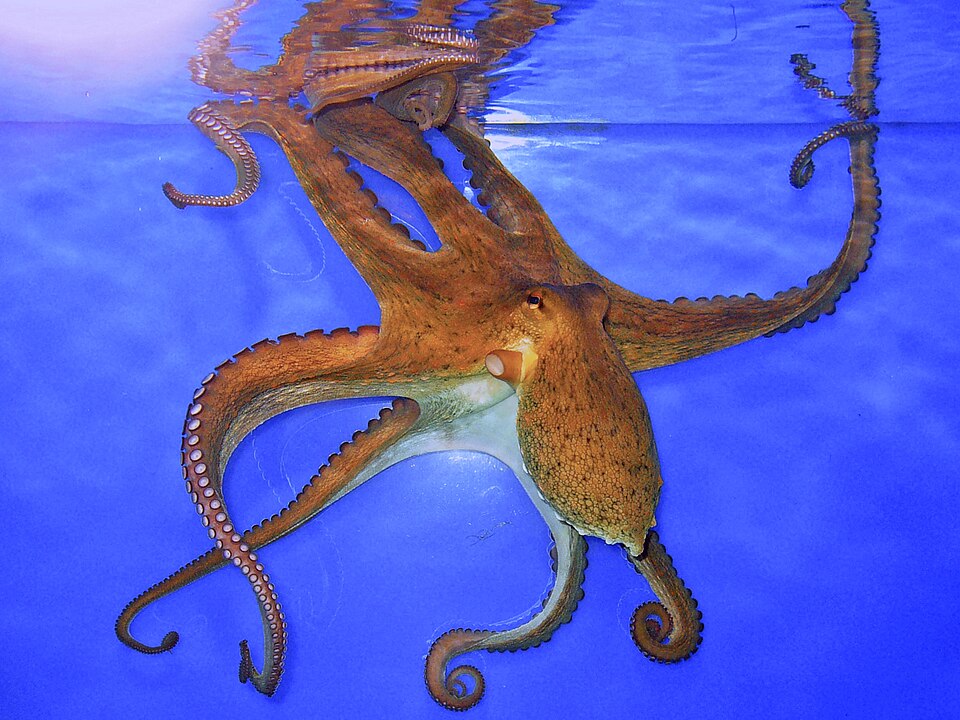
Scientists have lauded octopus, cuttlefish and squid for their intricate nervous systems, allowing them to expertly navigate the sea. So how did these crafty little coleoid cephalopods come to possess their so-fish-ticated intelligence? A study suggests that DNA reorganization dating back millions of years ago plays a key role in this.
Researchers at the University of Vienna embarked on a study to map out the complex architecture of several coleoid cephalopods’ genomes, which are simply the entire set of DNA of an organism.
In the vast array of chromosomes, Thea F. Rogers, Ph.D., and her colleagues found evidence that the reshuffling of DNA could have sparked a new set of gene interactions, thereby propelling the evolutionary innovations of coleoids.
“The genome isn’t just a sequence of genes. It’s folded into a complex three-dimensional structure,” Rogers said. “Understanding how that structure evolves is becoming increasingly important for understanding how new forms of biological complexity arise.”
DNA is frequently pictured as a long, twisted ladder of genetic material stretched out in a cell. However, the reality is that it must fold itself into an elaborate 3D arrangement, bringing DNA sequences that would be far apart from each other into proximity.
These connections can influence which genes are activated, at which times they are used and the strength they function at. As such, there is the opportunity for the same DNA sequences to develop new gene activity when they are folded differently.
A massive DNA reshuffling event in the coleoid ancestor was documented to have occurred around 270 million years ago.
This allowed genetic material that was previously separated to become closer and yield novel gene expression.
Over time, Rogers and colleagues explain that these interactions were subject to “regulatory entanglement.” The team defines the process as the “progressive accumulation of interdependencies among genomic elements,” leading certain points of contact to become embedded within the genome’s network.
In the genome also exists chromatin domains, which hold dense regions of DNA that are packaged with proteins. A chromatin domain has boundaries separating it from neighboring regions. Often housed in these domains are chromatin loops, which determine specific interaction points in a DNA fold.
Researchers employed Micro-C, RNA-seq and ATAC-seq to deconstruct and analyze the DNA of the Hawaiian bobtail squid, cuttlefish and California two-spot octopus.
These tools helped them gauge the contacts in DNA folds, locate which ones were accessible and measure which genes were active.
It was determined that despite their smaller genome size, octopuses have larger gene-associated loops compared to squid and cuttlefish. Median loop sizes were smallest in cuttlefish with a measurement of 1.3 million DNA base pairs, followed by squid which had 1.6 million, while the octopus had 2.9 million.
The team suggests chromosome fusion, which meshes separate DNA molecules into one, could serve as an explanation for these results. In a majority of loops, the octopus would link genes in a single chromosome, whereas the squid and cuttlefish counterparts had the genes spread across multiple different chromosomes.
Analyzing genome reorganization produced insights that were valuable pieces of an evolutionary puzzle. While the door is open for future testing, researchers were able to draw compelling connections between DNA folds and the regulatory landscape of coleoid cephalopods.