

The deep ocean remains one of the least explored environments on Earth and scientists continue to discover organisms that challenge existing knowledge of marine life.
A new study has identified a bright yellow coral off the coast of Costa Rica so unusual that researchers established an entirely new family to classify it.
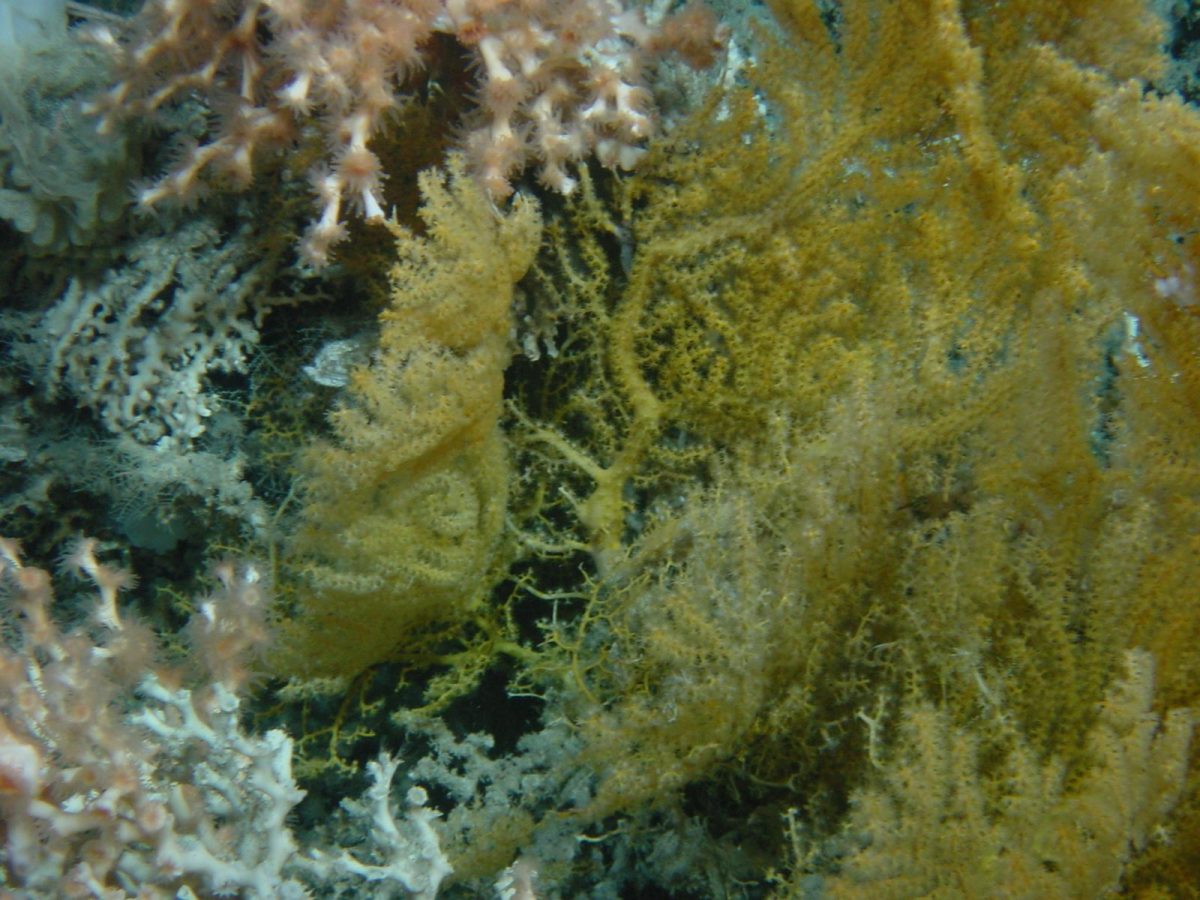
The coral, Laurinque elenya, was discovered on underwater mountains in the eastern Pacific Ocean. Researchers found the colonies between 360 and 529 meters below the surface, with some growing more than a meter tall. Its branching, tree-like structure and vivid golden color distinguished it from the surrounding seafloor.
Researchers collected specimens during underwater expeditions in 2019 and 2023 using SuBastian, a remotely operated vehicle operated by the Schmidt Ocean Institute. The coral grew on rocky surfaces covered with brittle stars.
This striking combination inspired the researchers to choose a name influenced by the fictional Elvish language created by J.R.R. Tolkien. Laurinque refers to a golden tree, while elenya means “stellar” or “of the stars.”
Classifying the coral proved more difficult than expected. Researchers initially examined three genes commonly used to identify evolutionary relationships, but each suggested that the species belonged to a different family.
To resolve these conflicting results, the team used phylogenomics, a technique that compares genetic information across hundreds of genes to determine how organisms are related.
The genetic analysis revealed that the coral did not belong to any previously recognized family.
Although it was related to the family Eunicellidae, its genetic characteristics and physical features were distinct enough to justify establishing a new family, Laurinqueidae, and a new genus, L. elenya.
The discovery demonstrates how genetic technology can help scientists identify organisms that might otherwise be misclassified.
Examining physical appearance alone may not reveal an organism’s true evolutionary relationships, particularly when species share similar characteristics.
The findings also highlight the importance of exploring deep-sea environments.
Coral gardens create complex habitats that support other marine organisms, contributing to biodiversity in ecosystems that remain difficult to study.
Identifying the species living in these areas is an important step toward understanding their ecological roles and protecting vulnerable habitats from human disturbance.
The study, published in the journal ZooKeys, provides new information about coral evolution and demonstrates how combining genetic analysis with physical observations can reveal previously unknown branches of life.
As researchers continue exploring underwater mountains and other understudied environments, they may discover additional species that expand scientific understanding of marine biodiversity.