

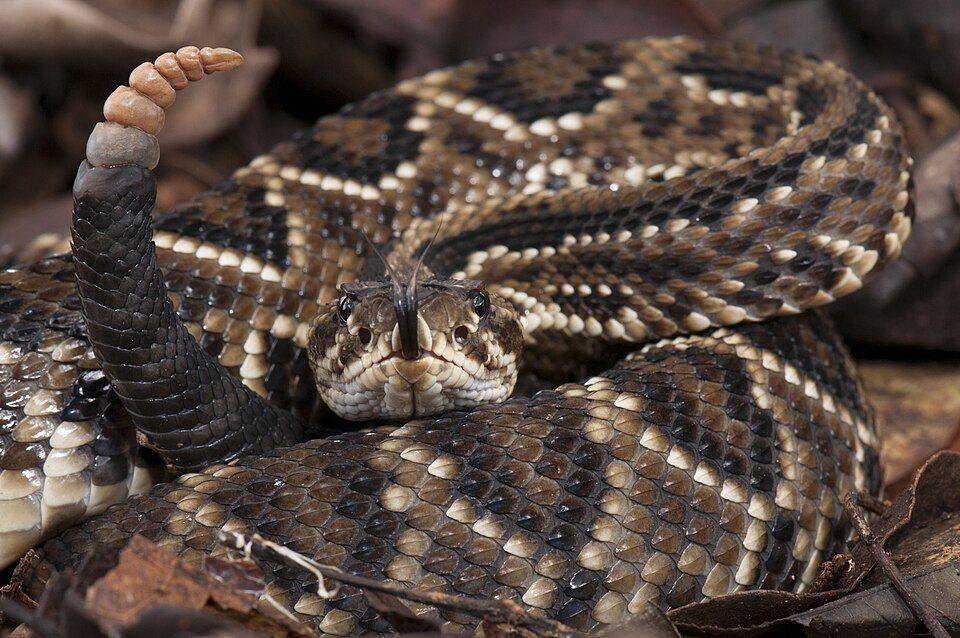
For more than a century, doctors have relied on slow and imperfect methods of harvesting antibodies produced in horses and sheep to treat snakebites. A discovery revealed that a better answer may have been circulating inside snakes the entire time.
Researchers at the University of Maryland found that combinations of toxin-blocking proteins in the blood of western diamondback rattlesnakes can neutralize venom from multiple viper species.
In laboratory tests, the mixtures were about 10 times more potent than the sheep-derived antivenom commonly used today.
According to the World Health Organization, snakebites kill an estimated 81,000 to 138,000 people worldwide each year and leave around three times as many with amputations or other permanent disabilities.
Antivenoms are currently made by repeatedly exposing horses and sheep to small amounts of snake venom, over weeks or months, so their immune systems produce the antibodies later harvested and purified for humans.
The process is expensive, time-consuming and the animal-derived antibodies can trigger immune reactions in patients. Effectiveness can also vary depending on the snake species and the venom type.
Yet, rattlesnakes appear to have a natural defense against the very venom that makes them so lethal. Self-envenomation is a real risk for them, whether through mouth tissue during a bite, by eating envenomated prey or through cannibalism.
“We’ve known from anecdotes for 100 years that vipers tend to be resistant to their own venom,” Sean Carroll, a distinguished biology professor at the University of Maryland, said. But what exactly circulated in their blood to provide protection remains unknown.
The first major clue came in 2022 when Carroll’s lab identified a protein called FETUA-3 in western diamondback rattlesnake blood. The protein blocked many of the metalloproteinase toxins, a family of toxins that break down tissue and cause bleeding. It stopped toxins from the venoms of several other rattlesnake species. The finding pointed to an evolutionary defense that protected snakes from accidental self-envenomation.
But venom is not a single toxin. It contains roughly 100 toxin proteins across multiple families, and its makeup varies between species. A single blocker, no matter how effective, cannot neutralize the full range of damage.
Each FETUA protein covered a different area of the venom’s damage. One reduced bleeding, while another interfered with enzyme activity. None alone could prevent death from a bite.
However, when combined, the proteins fully neutralized venom lethality and protected against venom from multiple viper species.
“We just have to keep testing various mixtures,” Carroll said.
The findings remain limited to laboratory tests, and metalloproteinases are only one of three major toxin families found in vipers. Carroll expects veterinary use before human treatment.
Scientists now have a model, and it was in the animal they were trying to defend against all along.