
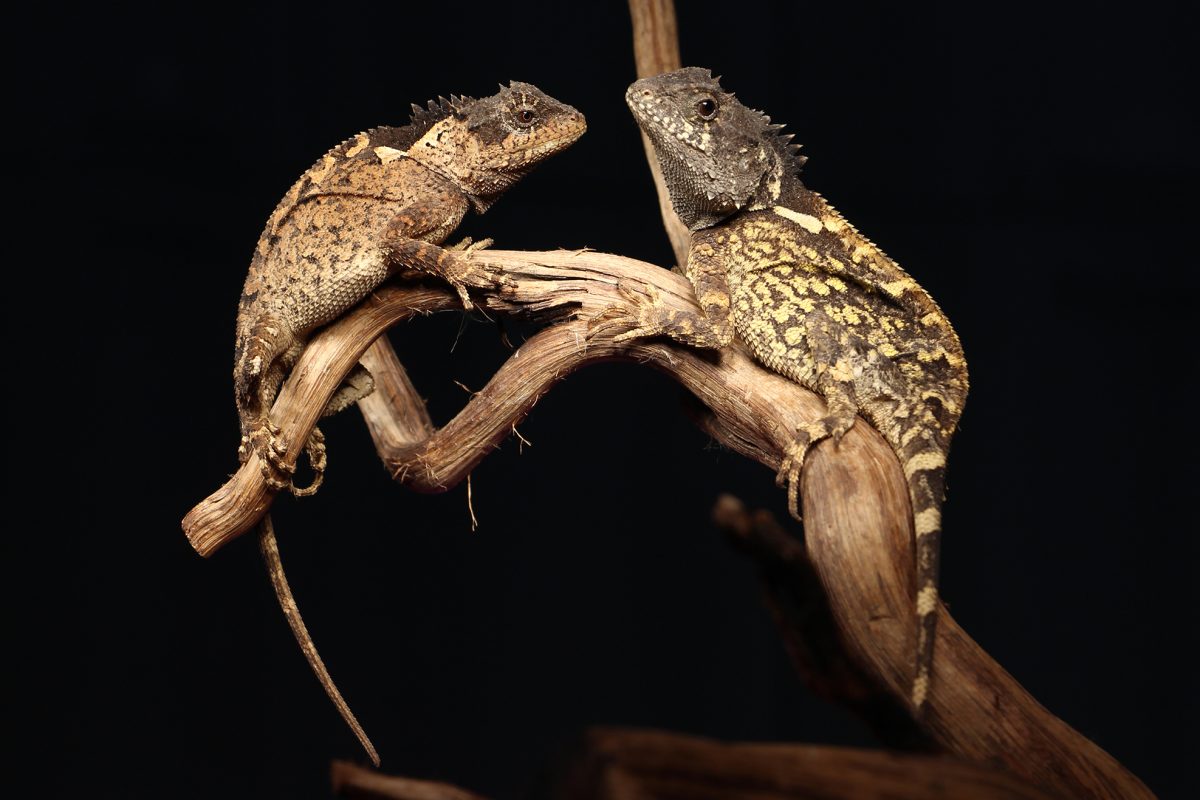
In the mountainous evergreen forests of the Tak-Kamphaeng Phet Province, Thailand, scientists discovered a new species of lizard. Researchers named the species Acanthosaura syrax, commonly called the Syrax mountain horned dragon, in reference to Queen Rhaenyra Targaryen’s dragon Syrax in the “Game of Thrones” prequel series, “House of the Dragon.”
A research team led by philosophy instructor and researcher Poramad Trivalairat, with colleagues from Chulabhorn Royal Academy and Kasetsart University, made the discovery of A. syrax in Mae Wong National Park. They observed its population to be scattered across a narrow band of land due to the park’s rugged terrain.
A. syrax has a distinct yellow-hued coloration and is among the smallest of the mountain horned dragons. Moreover, it lays an unusually high number of eggs. While many related species have a black eye patch, A. syrax instead bears a dark diamond-shaped collar marking on its neck.
In addition, the lizard carries the smallest recorded neck and back crest scales in the genus.
The male specimen of A. syrax possessed a mottled set of dark brown and pale greenish scales, whereas the female specimen’s scales were interspersed with a whitish-yellow pattern of scales.
When measuring the snout-vent length of A. syrax, scientists noted that females were around 1.27 times larger than males. Males had a recorded SVL ranging from 62.5 to 67.0 millimeters, while females’ SVL ranged from 75.5 to 101.2 millimeters.
Tail length followed a similar pattern: females had tails about 1.23 times longer than males. Males’ tail length ranged from 72.4 to 77.6 millimeters, while females had a tail length ranging from 85.5 to 106.9 millimeters.
Molecular analyses on the dissected tissue confirmed that the species had a different genetic profile than other mountain horned lizards.
Using pairwise sequence alignment, scientists compared the DNA sequences from the ND2 gene in various species of mountain lizards. There was a minimal pairwise sequence difference of 0% to 0.01% between members of the A. syrax species.
When A. syrax was compared to related species of mountain lizards, the pairwise sequence difference was substantially high, ranging from 0.14 to 0.21%.
Similar results were produced when the test was run with the COI gene.
Intraspecific variation in sequences of COI was minimal, ranging from 0% to 0.34%. Conversely, there was a significant genetic difference of 14.96% to 28.13% when comparing A. syrax to other species from the same genus.
Trivalairat and his team are working to promote more protection for the high-elevation forests of Mae Wong National Park.
Considering the A. syrax population is isolated by the park’s rugged terrain, they are especially vulnerable if the forest is placed under pressure from human activity.
Through their advocacy for protecting the park’s forests, the team believes they can help other at-risk species that share the habitat such as the Asian forest tortoise, Oldham’s leaf turtle and the Indochinese tiger.