
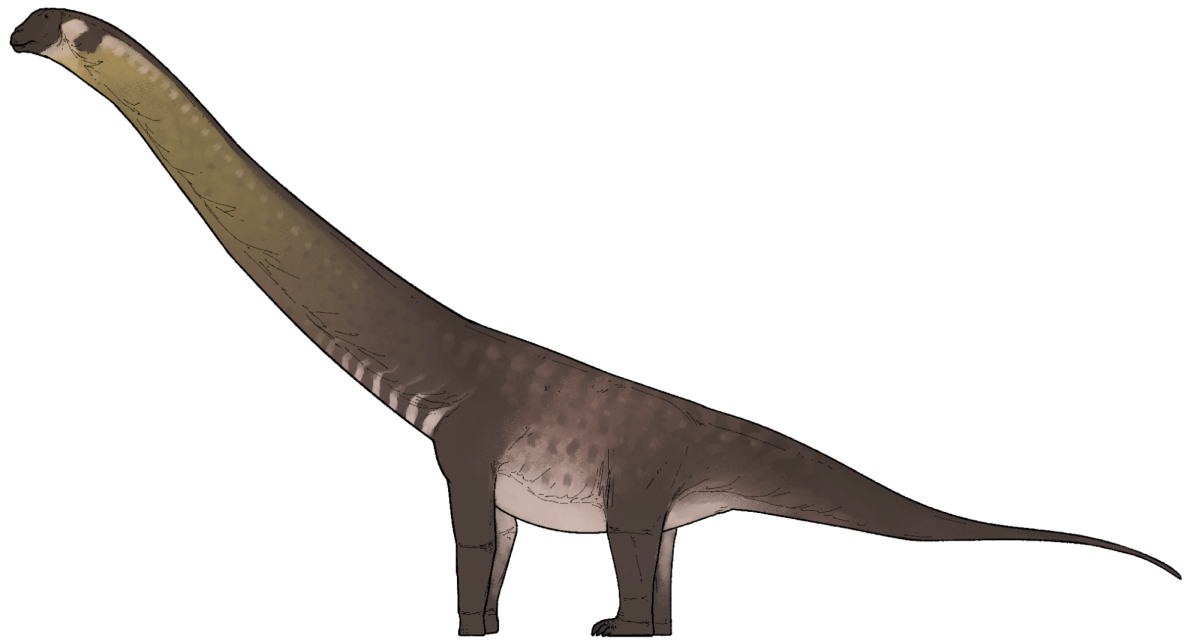
A construction crew was sent out to build a road rail terminal in Davinopolis, Brazil, where they found a 20-meter-long fossil, now named Dasosaurus tocantinensis.
The fossil was discovered by archaeologists tracking the Davinopolis construction project Initially, it was thought to have been part of megafauna mammals that existed alongside early humans until Elver Luiz Mayer, a professor at Federal University of the Sao Francisco Valley in Bahia, confirmed it wasn’t, based on its structure and age.
Mayer, who specializes in mammals dating back to the Quaternary period, said, “Given its depth of about eight meters, I realized that it was much older. The age of the geological formation was already known from previous research and indicated that it was material from the transition from the Lower to the Upper Cretaceous, about 120 million years ago.”
The fossil was carried to Pará for analysis, then returned to Maranhão, where it is now kept in São Luis at the State Center for Natural History and Archaeology Research.
The bone microstructure analysis led by researchers Titio Aureliano and Aline Ghilardi of the Federal University of Rio Grande do Norte displayed a growth pattern similar to older sauropods with traits relative to titanosaurs, a species related to D. tocantinensis, showing that evolution in size and bone occurred earlier than previously known.
This might help answer how certain species of dinosaurs were able to grow up to such massive heights.
Fossils found in Spain suggested that dinosaurs migrated over Gondwana from Europe down to South America.
Researchers suggest that ancestors of the Maranhão species crossed through North Africa approximately 120 to 140 million years ago.
The discovery makes D. tocantinensis the largest dinosaur found in Maranhao to date, where smaller species have been found such as diplodocid Amazonsaurus maranhensis, measuring 10 meters in length.
The species’ name derives from the location it was found, “Daso” translates to “forest” and “maranhão” came from Portuguese colonizers who described the forest as a “dense tangle.” Meanwhile, the second part of the name, “tocantinensis” refers to the Tocantins River, not far from where the fossils were dug up.
The research group is currently discussing continued excavation at the site with the construction company.
Finding more fossils could reveal information about the D. tocantinensis’ family tree.
“Because it includes tail vertebrae, a 1.5-meter femur, ribs, foot bones and arm and leg bones, this is considered a relatively complete specimen. We believe there are more fossils from this same specimen yet to be excavated at the site,” said Max Langer, a professor at the Ribeirão Preto School of Philosophy, Sciences and Letters at the University of São Paulo, who also participated in the study.