
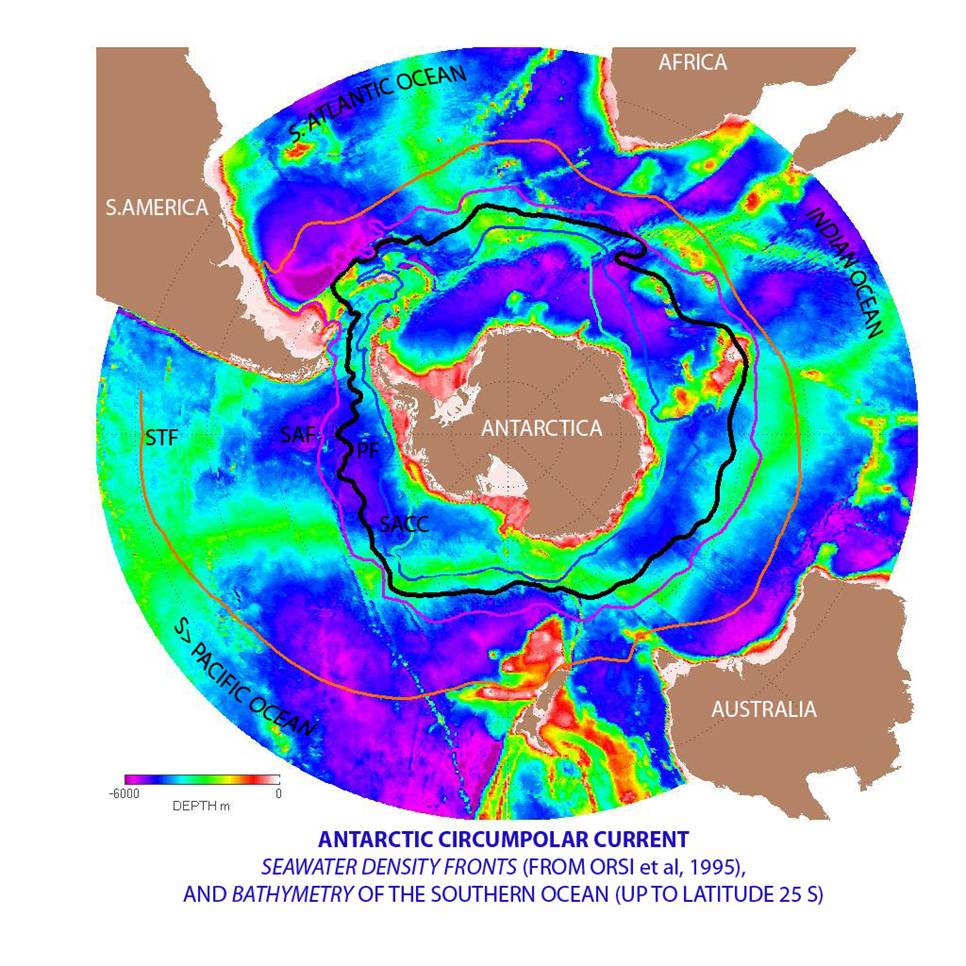
The Antarctic Circumpolar Current possesses more than 100 times the flow of all the world’s rivers combined. According to research published in the Proceedings of the National Academy of Sciences journal, it is a major contributor to the global climate system.
Roughly 34 million years ago, Earth transitioned from a warm greenhouse environment to an icehouse one. During this time, the ocean passages between Antarctica, South America and Australia expanded. Simultaneously, the ACC and the Antarctic ice sheet began to form.
The atmospheric carbon dioxide levels were about 600 parts per million, a level that has not since been achieved.
Hanna Knahl, a climate modeler at the Alfred Wegener Institute, advised caution when looking at the past to predict the climate of the future.
”The climate of the past can of course not be projected 1:1 onto the future,” Knahl said. “Our study shows that the circumpolar current in its ‘infancy’ influenced the climate very different than today’s fully developed ACC does.”
Decisions should not be rushed when it comes to understanding the strong currents of the present. Researchers should proceed with caution when analyzing the ACC to inform decision-making.
To study how the ACC formed, Knahl’s team ran climate simulations based on the Earth’s geography roughly 34 million years ago, when Australia and South America were closer to Antarctica.
The simulations were run alongside a model of the Antarctic ice sheet from a 2024 study that tracked how the currents evolved, looking at land, atmosphere and ocean systems.
The results of the model were then compared with geological reconstructions from the same time, allowing the team to test how well their simulations matched real-world evidence.
The simulations confirmed the importance of the Tasman Gateway, a seaway between Antarctica and Australia.
When Australia had moved further away from Antarctica and the westerly winds passed through the Tasman Gateway and Drake Passage, the ACC started to form.
The westerly winds created the climate-cooling effects of the ACC. This eventually allowed the current to fully develop.
During its early stage, the Southern Ocean looked different because the ocean passages were open, but the current had not formed a continuous loop. Instead, the Pacific region remained calm, while a strong flow developed in the Atlantic and Indian regions.
This research gives scientists the enhanced ability to interpret recent changes in Southern Ocean circulation. It helps them understand how the immense, clockwise ocean current circling Antarctica helps remove carbon dioxide from the atmosphere and stores it deep in the ocean, which allows for the cooler climate of the Cenozoic Ice Age that still exists.
It is evident in the permanently ice-covered polar ice caps, in which warm and cold periods alternate.
This allows people to understand how the currents of the ocean were different in the past and how that has influenced Earth’s climate system.