
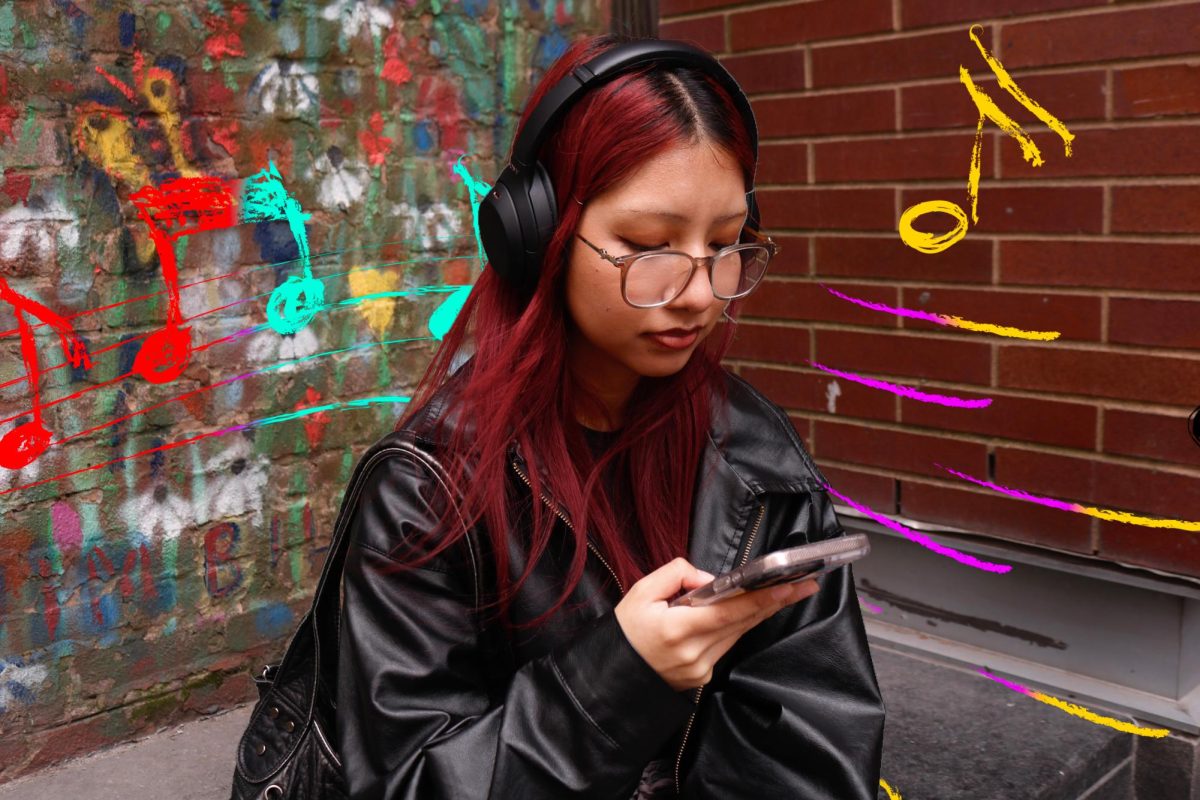
Genetics is often explained through charts, lab reports and medical terminology that can feel distant from patients’ lives. But for some rare disease advocates, music has become a way to make these stories easier to hear. By translating genetic sequences into sound, a group of physicians, composers and patient advocates explored how art can raise awareness for conditions that are often overlooked.
Aditi Kantipuly, a physician and rare disease advocate, has spent years working with families affected by rare genetic conditions. Through that work, she saw how isolating a diagnosis can be, especially when a condition receives little public attention or funding. Her interest in incorporating the arts grew from a desire to make rare diseases more visible and easier for others to understand.
“I always saw music as a way to connect with people,” Kantipuly said. “And so how can we use music as a vehicle to build bridges with this community?”
Kantipuly eventually met composers who turn genetic information into music, a process known as DNA sonification. Rather than presenting genetic sequences as strings of letters, composers assign musical elements to parts of the sequence such as pitch, rhythm or melody.
Stephen Andrew Taylor, a composer and professor of music at the University of Illinois Urbana-Champaign, used this approach in works based on genetic material, including sequences connected to rare diseases and other biological themes.
Taylor described the process as data-driven music rather than a direct scientific chart. DNA is made up of four bases, represented by the letters A, T, C and G, but composers have many choices in how these letters become sound.
Some may use the bases themselves, while others may work with amino acids or smaller sections of a gene to create a musical piece while still drawing from biological information. In that sense, the music does not replace scientific explanation but gives listeners another way to engage with it.
An example of this approach came from a case of severe combined immunodeficiency or SCID, a rare disorder that affects the immune system. After learning about a young boy in Alberta, Canada, who had the condition, Kantipuly collaborated with Michael Frishkopf, a composer at the University of Alberta, to create music from the gene involved in his case. The affected gene contained about 32,000 bases. When Kantipuly sent him the full sequence, Frishkopf recalled wondering, “What do you do with 32,000 letters?
Frishkopf first experimented with assigning sound to each base in the sequence, but the full genetic sequence was too long and complex to work as a conventional melody. Instead, he searched for patterns within the genetic code and found a 64-base section that appeared twice. That repeated sequence became the foundation of the composition, allowing him to shape genetic information into a musical piece while keeping the work connected to the biology behind the condition.
The project later took on a deeper personal meaning when Frishkopf shared the composition with the boy’s mother. She wrote lyrics to accompany the music, adding a human voice to a piece that had started from genetic code. The work was eventually performed live, helping bring attention to SCID and the family behind the sequence. This way, the composition became more than an interpretation of DNA; it became a way to connect a rare diagnosis to a story for people to remember.
This effort has also brought in patient advocates such as Casey McPherson, a musician and founder of the To Cure a Rose Foundation. McPherson uses music to tell the story of his daughter Rose, who has an ultra-rare genetic condition. For him, music became a way to connect people emotionally to the realities of rare disease research, fundraising and treatment development. His work reflects a broader goal of making these conditions feel less abstract and more connected to the lives of families trying to find answers.
Together, Kantipuly, Taylor, Frishkopf, McPherson and other collaborators use music to raise awareness of rare diseases in ways that go beyond traditional medical communication. The work includes performances, genetic music projects and efforts to build a larger platform for rare disease advocacy.
By turning genetic sequences into music, the collaboration offers a new way to connect science, art and the patient experience. In doing so, it gives rare disease communities another form of visibility, one that does not rely only on being seen but on being heard.