
Since the start of the Mamdani administration, the presence of sidewalk sheds has decreased by 15%. In their place are new, stylized sheds that are designed with the intention to allow more light to reach sidewalks and storefronts.
This creates a more pleasant look and increasing pedestrian visibility and safety.
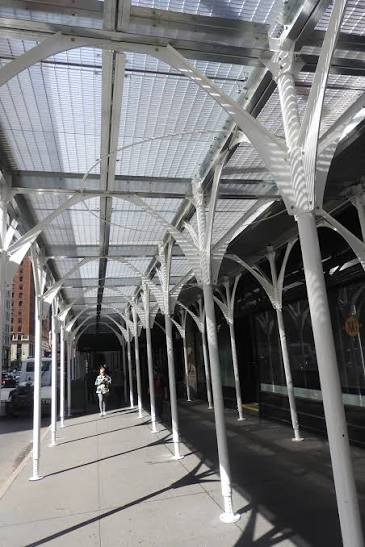
Developed by the architecture firm Practice for Architecture and Urbanism, two new designs are showcased outside the Department of Buildings headquarters in Lower Manhattan.
The DOB also presented another couple of designs by architecture firm Arup, which TIME Magazine deemed as one of the best inventions of 2026.The two types of shed designs by PAU are the Baseline Shed and the Speed Shed, both of which are created for different purposes.
The Baseline Shed, available in heavy-duty and light-duty versions, has a transparent decking and angled roof that allows light to pass through.
This design is focused on improving sightlines to ground-floor businesses, while creating an open sidewalk. The Speed Shed’s design caters to light-duty use, focusing on catching debris with its rockfall netting roof.
Like the Baseline Shed, it also has an angled roof that lets light pass through. However, it has detachable wheels, which allows the structure to be portable. Deputy Mayor for Housing and Planning Leila Bozorg said, “With fewer sheds on our streets and new, more attractive sheds going up soon, we’re making significant progress toward safer and more welcoming sidewalks and open spaces.
The teams at DOB, Arup, PAU and public servants across the city are dedicated to creating more vibrant streetscapes, and New Yorkers are already seeing results.”These designs may be a promising solution to NYC’s scaffolding conundrum.
The issue was created by a long-standing loophole that building owners take advantage of.
Dating back to 1980, NYC’s Facade Inspection Safety Program requires buildings in NYC over six stories tall to be inspected every five years for risk of falling debris.
If there is any potential danger found, building owners must install scaffolding to protect pedestrians. Because of this rule, building owners have found it cheaper to maintain scaffolding than to pay for repairs.
Since there is no deadline for these fixes, scaffolding throughout the city can stay up for years.
Though the effectiveness of its design and function may be questioned by some, the overall effort to create these installments are an innovative way to create little improvements on our streets.