
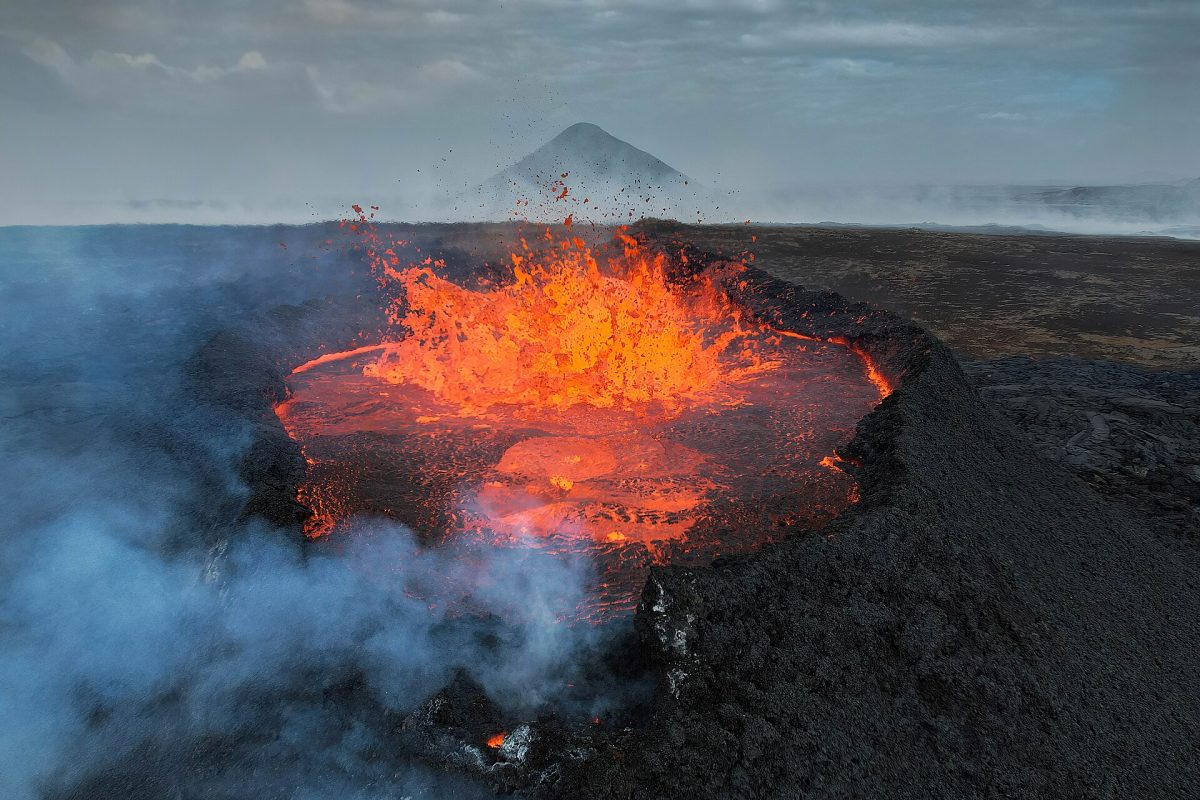
Vibrant streams of orange lit up the sky at Hawaii Volcanoes National Park as the Kīlauea volcano spewed out fountains of incandescent lava. Over the past two years, scientists have been captivated by the active volcano’s uptick in lava fountaining.
For nearly 200 years, the Kīlauea volcano has erupted on and off. However, Dec. 23, 2024, marked the beginning of the volcano’s recurring lava fountains after it erupted inside the Halema’uma’u summit crater.
It has had 55 episodes of fountaining since then, reaching a peak fountain height of 1,770 feet during episode 43, according to the U.S. Geological Survey’s Hawaiian Volcano Observatory.
Volcanic eruptions, lasting anywhere from hours to even years, can produce occasional lava fountains.
Kīlauea’s behavior is unusual in that it is rare for the fountaining to occur repeatedly in distinct bursts separated by minutes to weeks during a single eruption.
“Thanks to their rarity, researchers have known relatively little about what initiates, sustains and ends these episodic fountains,” Ashton Flinders, a research geophysicist at the USGS Hawaiian Volcano Observatory, and his colleagues said.
There are two prevailing hypotheses as to what could trigger this sporadic phenomenon.
Lava fountains typically form in basaltic volcanoes, such as Kīlauea, when the dissolved gases inside magma bubble to the surface and the pressure changes create a jet-propelled mixture of lava and gas.
Another possibility is that carbon dioxide builds up as a pressurized foam on top of magma before it violently bursts.
Thanks to its consistent fountaining, it has served as an incredibly valuable tool for putting these hypotheses to the test.
Using specialized instruments, scientists at the observatory have been recording data on its seismic activity, temperature, low-frequency acoustics, how much the ground swells or deflates and the gases that escape.
Based on their observations, the team found strong indicators of activity in the Kīlauea caldera, a bowl-shaped depression that forms after a magma chamber empties and the ground above the chamber collapses inward.
Before an episode, the caldera would swell and tilt, suggesting magma was gathering beneath.
As they continued, the team noted a pattern of minutes-long bursts of seismic energy along with low-frequency acoustics that came before fountaining began.
Researchers link these signals to the buildup and release of trapped gases in magma, which force it to rise and fall through narrow volcanic vents in the rock like a car engine’s piston.
It was also noted that there was little carbon dioxide in Kīlauea’s gas burps, compared with sulfur dioxide.
While this insight weakens the carbon dioxide foam hypothesis, there is still much to be explored about lava fountaining.
“This is just a preliminary glimpse into this phenomenon, and a lot of questions remain,” Flinders and his colleagues said.