
Around 150 million years ago, during the late Jurassic period, an herbivorous dinosaur called Diplodocus roamed North American plains to feast on vegetation. For the first time, scientists have identified fossil evidence that the long-necked dinosaur’s escapades landed it as far as Europe.
Diplodocus, affectionately nicknamed “Dippy,” is well-known thanks to the debut of its fossils at the Carnegie Museum of Natural History in the early 1900s.
Following the debut, life-size replicas of the fossils were gifted to museums around the world, including to England, France, Spain, Argentina and Russia.
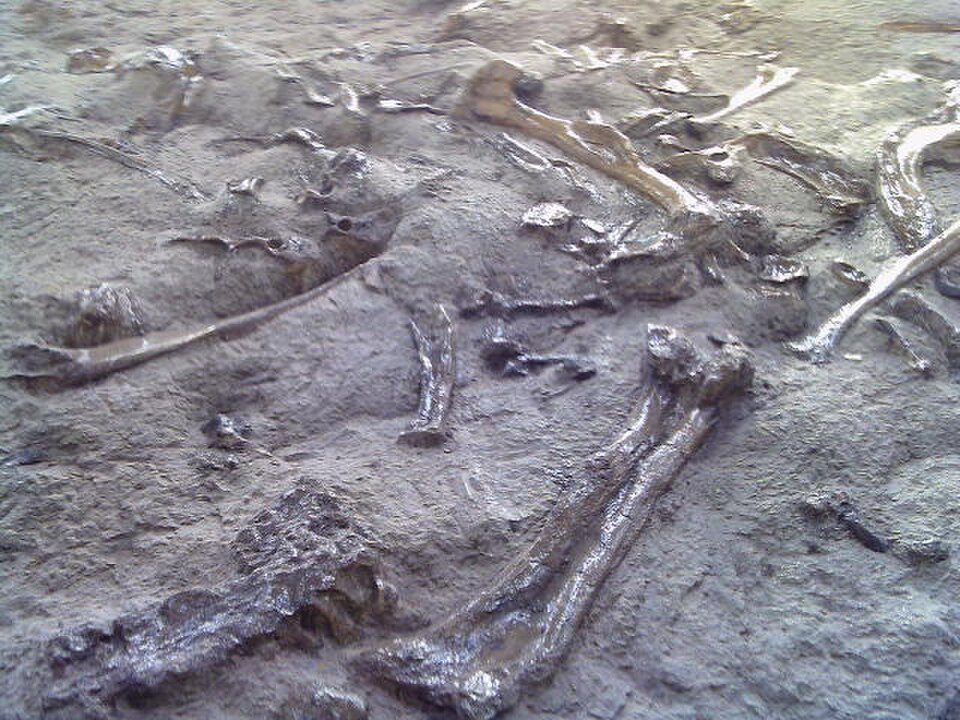
At the La Tejería excavation site near the municipality of El Castellar in Teruel, Spain, researchers unearthed well-preserved fossils belonging to the Diplodocus specimen.
Lead researcher Sergio Sánchez-Fenollosa, a doctoral student at the Dinópolis Foundation, described the discovery process as an exciting part of the paleontological “puzzle” of the Diplodocus’ past.
“Paleontological studies like this one help us better understand the history of life on Earth, reconstruct ancient ecosystems, and understand how they changed through time,” Sánchez-Fenollosa said.
The excavation produced a partial skeleton consisting of 14 caudal vertebrae and several chevron bones, which supported muscles and blood vessels along the tail. Based on models of diplodocine tail bones, the caudal vertebrae appear to correspond to the 22nd to 35th vertebrae in the caudal series, placing them near the middle of the tail. The underside of the caudal vertebrae had a deep groove of about 1 centimeter deep running along it.
The chevrons were V-shaped from the front and forked when viewed from the side. Furthermore, the fossils were noted to have large cavities which corresponded to where the tail’s air pockets would have been, along with deep grooves running alongside the underside of the tailbones.
The Diplodocus specimen discovered at the La Tejería site was found to have a body length of around 25 meters long, which is comparable in size with other diplodocine specimens from North America.
Using maximum parsimony analyses, scientists curated the physical traits of the fossils and used computational algorithms to place them within the dinosaur family tree. For further confirmation, a Bayesian inference analysis calculated the fossils’ most statistically probable phylogenetic affinities.
“As we looked more closely at the anatomy, we began to identify a combination of features characteristic of Diplodocus species,” Sánchez-Fenollosa said.
The findings offer compelling evidence that dinosaurs of the late Jurassic period were able to migrate from North America to Europe through land bridges after the supercontinent Pangaea began to split apart.
Until now, Diplodocus fossils had only been found in Morrison Formation, a sequence of sedimentary rock that extends throughout the western U.S., leading paleontologists to believe the long-necked dinosaur was exclusive to North America.
“The fossils of all these dinosaurs, including those of the new Diplodocus specimen, make Teruel a reference place for understanding this great diversity,” said Sánchez-Fenollosa.