
Growing food on the moon is one of the biggest challenges scientists face as space agencies plan longer missions beyond Earth.
Astronauts who aim to live on the moon for long periods are unable to rely only on packaged food. Because of this, researchers are studying whether crops could one day grow directly in lunar soil.
A recent study suggested that chickpeas might be able to grow in simulated moon soil with the help of fungi and compost.
Lunar soil is very different from the soil on Earth. It is extremely fine, sharp and dusty. It also lacks organic matter and key nutrients that plants require to grow. Moreover, the soil contains metals that can be harmful to plants.
“It is a hazard unamended,” space biologist Jess Atkin of Texas A&M University told Science News. “It is the worst. It is awful.”
Due to these harsh conditions, growing crops in lunar soil is difficult.
Earlier experiments showed that plants can sprout in moon soil, but they grow slowly and often show signs of stress.
To improve the soil, researchers tested whether biological helpers could make a difference. They used chickpeas, a plant chosen for its hardiness and high protein content.
“I’m obsessed with the plant,” researcher Sara Oliveira Santos of the University of Texas at Austin told Science News.
“The fact that we’re able to bring these add-ons and help the plant get to such a stage that it produces seed, I think is really important.”
The scientists mixed simulated lunar soil with vermicompost, a nutrient-rich fertilizer created when worms break down organic waste. Vermicompost improves soil structure and adds in important nutrients.
They also added arbuscular mycorrhizal fungi, a type of fungus that forms a partnership with plant roots. These fungi help plants absorb water and nutrients while also trapping harmful metals in the soil.
The chickpeas were planted in different mixtures of lunar soil simulant and compost. Some plants were also treated with the fungi.
The chickpea plants were able to grow and even produce seeds in soil mixtures containing up to 75% lunar regolith simulant.
The plants grown in lunar soil still present signs of stress compared with those grown in regular Earth soil. However, it was noted that the plants treated with fungi survived longer.
The fungi also improved the soil itself. Their tiny, thread-like structures helped bind soil particles together, which allowed the soil to be more stable and easier for roots to grow through.
Atkin believes this approach could help future astronauts grow crops in space.
“The plants are amazing, it’s great we can get seeds,” she said. “But they’re really the host for the transformation into the soil.”
Scientists are now studying whether the seeds produced in the experiment could grow new generations of chickpea plants and whether the crops would be safe to consume.
If the research is successful, chickpeas or similar crops could one day help astronauts grow their own food on the moon.
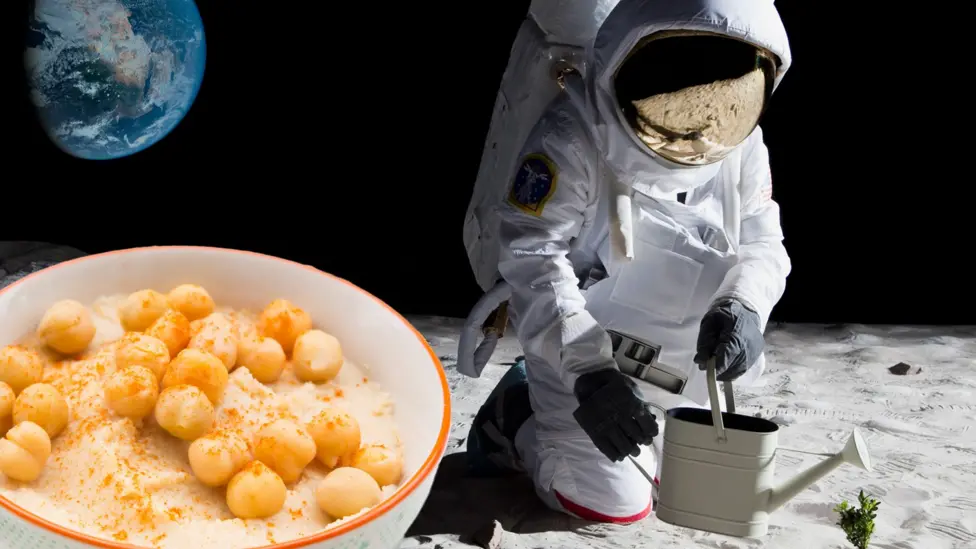
Santos even joked about the future possibilities, saying she hopes one day astronauts might enjoy “moon hummus.”