

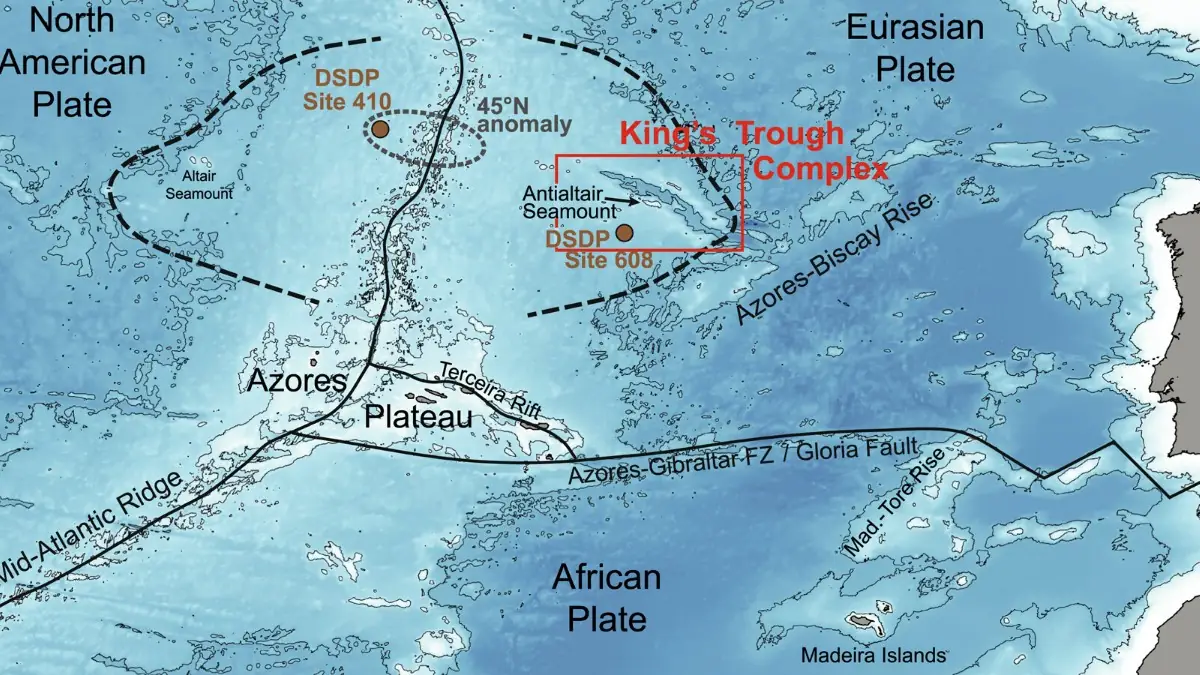
About 1000 kilometers off the coast of Portugal, hidden beneath the surface of the Atlantic Ocean, lies one of the most interesting geological features on Earth.
Stretching roughly 500 kilometers, the King’s Trough Complex contains vast basins and parallel trenches so immense that they dwarf the Grand Canyon.
Until recently, how this feature was formed remained a relative mystery.
The oceanic crust responsible for the King’s Trough was formed between 60 and 26 million years ago at the Mid-Atlantic Ridge. There, molten rock rises from the mantle, cools and becomes the new ocean floor, a process that can be thought of as the Earth slowly unzipping itself.
A team of international researchers led by the GEOMAR Helmholtz Centre for Ocean Research Kiel in Germany pieced together how the trough formed.
Between roughly 24 and 37 million years ago, a tectonic plate boundary separating the European and African plates moved through this region. As it did, the seafloor tore apart and fractured, similarly to a zipper opening from east to west.
Usually, the plates pulling apart would form a new spreading ridge. But in this case, the crust was being pulled apart and slid sideways at the same time – a process known as transtension.
The researchers’ key finding is the likely involvement of a mantle plume, a column of abnormally hot material rising from deep within the Earth toward the surface. The plume thickened and thermally weakened the overlying rock in the region long before the plate boundary arrived. The pre-existing weakness is what drew the boundary there in the first place.
“This thickened, heated crust may have made the region mechanically weaker, so that the plate boundary preferentially shifted here,” Dr. Jörg Geldmacher, a marine geologist at GEOMAR, said. That combination of thermal softening and mechanical stretching, the team argued, allowed such a large and deep canyon system to have developed.
Since the crust had already been weakened, it fractured easily. The result was a graben, a block of crust that drops down between two faults during extension.
Magnetic anomalies, patterns formed as lava cools and records Earth’s magnetic field, showed that the trough opened progressively from east to west, with rifting beginning on the eastern side and spreading westward.
This distinguishes the King’s Trough Complex fundamentally from familiar land-based canyons. The Grand Canyon, in all of its grandeur, was carved by the Colorado River over millions of years.
The King’s Trough, on the other hand, was shaped by internal Earth processes such as mantle melting, plate boundary migration and lithospheric stretching.
The King’s Trough stopped forming when the plate boundary traveled south.
However, a similar process is underway near the Azores today, where a comparable trench system known as the Terceira Rift is forming.
The discovery reveals how dynamic the Atlantic Ocean still is. The ocean floor, often seen as static and unchanging, is very much alive.