
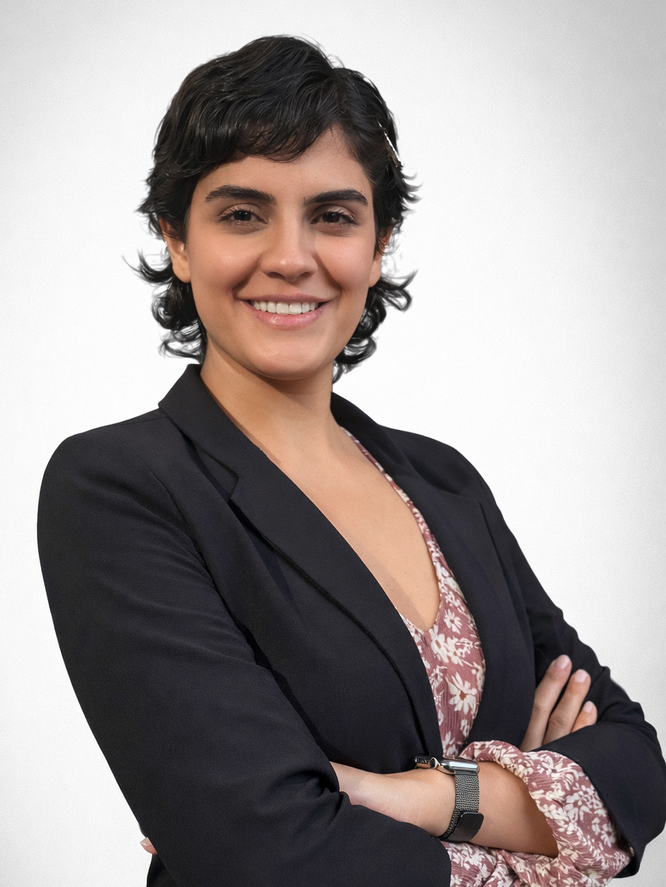
Setareh Seraj is not the kind of professor students forget once the semester ends. Her hands-on, high-energy approach to teaching has made her one of the more memorable instructors at the Zicklin School of Business. This year, that reputation earned her the school’s $300 Dean’s Teaching Award.
Seraj is entering her final year in Baruch College’s PhD program in computer information systems, which she expects to complete by summer 2027. Along the way, she has taught as an adjunct lecturer at Zicklin since 2022, teaching Introduction to Information Systems and Business Fundamentals.
Her road to the classroom did not begin in business school. Seraj earned a bachelor’s degree in civil engineering in Iran, where she published research on waste management. She completed a master’s degree in management science and technology at Amirkabir University of Technology and worked in consulting before coming to New York for her PhD.
Seraj describes teaching as closer to performing than lecturing. She treats every class as its own experiment, reading the room and adjusting on the fly while the core material stays the same. “It’s a very live, performative act,” Seraj told The Ticker in an interview. “It’s like a theater where my students and I are creating it together.”
Connection comes before content which Seraj said she learned as a student. In ninth grade, she failed algebra because she could not stand the teacher. The next year, with a teacher she loved, she earned an A+ in the same subject.
“If I come in with a big ego as your professor and we never meet each other on an equal human level, you never learn anything from me, even if I’m the most fantastic teacher in the world,” she said. Once that human connection is made, she added, everything taught in class becomes far more interesting.
Her courses already reflect that philosophy. Lectures give way to games, Harvard-style case studies and team projects. She recently designed and implemented her own cases about artificial intelligence bias, which have been accepted for presentation and publication at the Information Systems and Computing Academic Professionals education conference this November.
The cases add to a research record that include presentations at conferences such as the Workshop on Information Systems and Economics and the Conference on Information Systems and Technology and papers currently under review at academic journals. Next on her list is taking a class outdoors for a first-day picnic and bringing dance and meditation into the classroom.
Seraj sees it all as part of a bigger mission facing educators now that students can find almost any piece of information on their own through AI or YouTube. “We have to defeat this AI,” she said, “by accepting it completely and teaching what it can’t touch: human values.”
She added, “You can learn anything with YouTube and AI. You really don’t need a teacher unless they do something different.” For Seraj, that difference comes down to coaching and genuine human interaction in the spirit of Ted Lasso, the parts of teaching she believes no algorithm can replace.
She pointed to Nvidia CEO Jensen Huang’s recent definition of smart in the age of AI: “My personal definition of smart is someone who sits at that intersection of being technically astute but [with] human empathy, and having the ability to infer the unspoken, the around the corners, the unknowables.”
Outside the classroom, Seraj studies how technology and economic pressures shape labor markets and everyday online behavior, work she compiles under the title of her dissertation, “Screens, Stress and Careers.”
Seraj also credits Baruch’s diversity as one of the most meaningful parts of her time here, she stated it shaped how she teaches, “Diversity became my comfort zone.”
When asked whether she would recommend pursuing a PhD, Seraj did not sugarcoat it. “Interest and passion are not enough,” she said. She called it a slow four to six-year marathon that runs on discipline and focus long after the excitement fades, a lesson she says applies well beyond academia.