
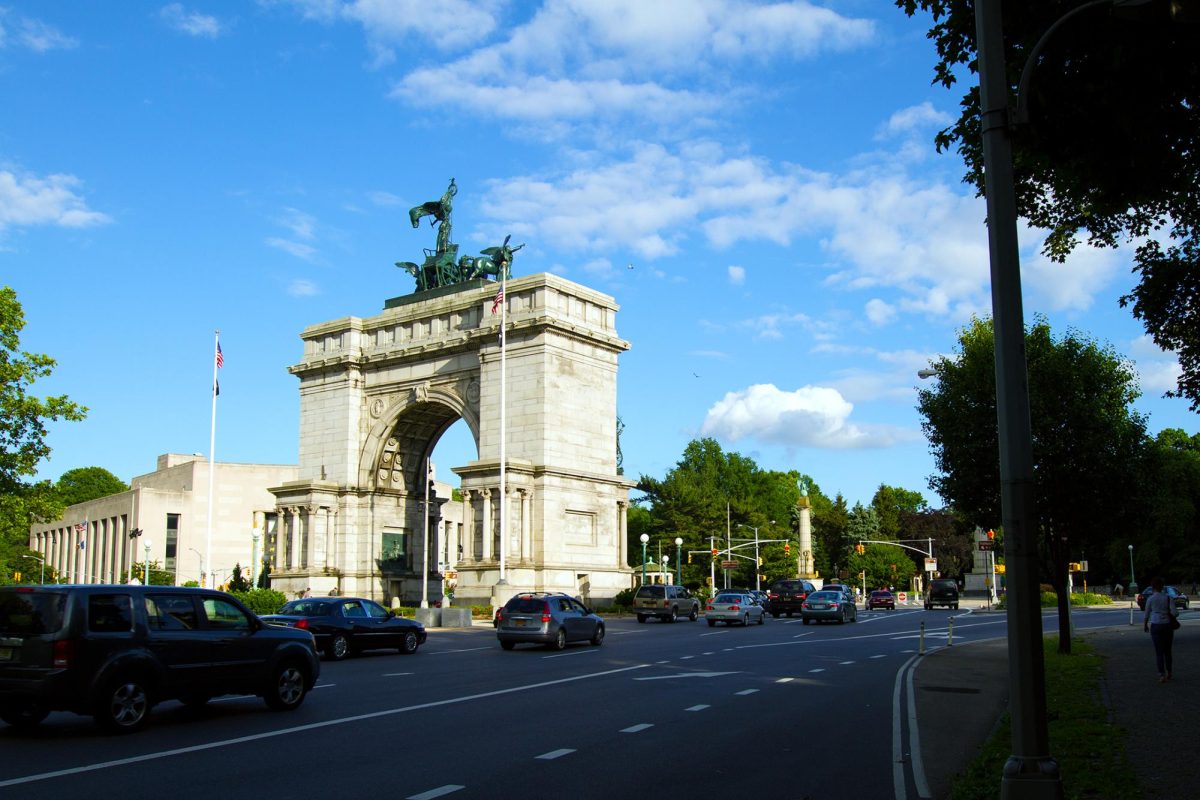
Mayor Zohran Mamdani’s plan to permanently close part of Brooklyn’s Grand Army Plaza to car traffic is the right call, even if it has arrived late. The proposal, announced in April, would shut down the southern stretch of the 14-acre oval to vehicles and stitch Prospect Park back to the Soldiers’ and Sailors’ Memorial Arch.
The plaza was designed in 1867 by Frederick Law Olmsted and Calvert Vaux as a grand pedestrian entrance to Prospect Park. For decades, New York has shaped its busiest public spaces around drivers at the expense of pedestrians in a city where most residents do not drive. Grand Army Plaza is the most glaring case, and Mamdani’s redesign is the first serious attempt to fix it.
The plaza’s danger is well documented. Its central roadways and outer ring saw an alarming 219 traffic injuries between 2021 and 2025, according to The New York Times. Pedestrians today must thread between a string of small concrete islands while traffic merges around them in multiple lanes.
Under the new design, the four lanes of car traffic dividing the arch from Prospect Park would close. Pedestrian and cyclist crossings would drop from 39 to 24, and 10 crosswalks would be elevated to function as speed bumps. Roughly three-quarters of an acre of public space would replace the asphalt where vendors at one of the city’s largest farmers markets already squeeze in alongside traffic.
The B41 and B69 bus routes, two of the borough’s busiest lines, would also be reconfigured around the new layout. Combined with new center-running bus lanes planned for Flatbush Avenue, the redesign would speed up trips for the riders who depend on them most, primarily black and low-income riders.
Visitors to the Brooklyn Public Library’s central branch, who are forced to wait on cramped islands while cars drive on either side, would be able to walk to the door without choreographing a small act of survival. For families with strollers, students with stacks of books or anyone moving on foot, that single change matters more than any rendering can show.
Mamdani has called the plan “long overdue,” but the description undersells the wait. The New York Times noted that the plaza was once chaotic enough to inspire a group of Brooklyn residents in 1927 to install an unofficial sign called the Death-O-Meter, tracking traffic fatalities at the loop. The current redesign rests on Department of Transportation workshops that began in 2024, layered on decades of community pressure.
None of this should be controversial in 2026. The plaza sits at an unparalleled convergence of civic life: subway lines, bus routes, Brooklyn’s central library, the borough’s second-largest park and one of the city’s largest farmers markets. Yet for decades, the question of who this space belongs to has been answered with four lanes of asphalt that serve only a fraction of the people passing through.
Critics of the plan, including some nearby residents, argue that the reroute could slow emergency response or push traffic onto smaller side streets. Those concerns are not trivial, and the city should have answers ready. For instance, drivers cutting from Union Street to Eastern Parkway would face a slightly longer trip around an inner two-way ring.
But the tradeoffs are smaller than they sound. The DOT argued the new layout could actually move traffic more smoothly by spreading out the spots where cars stack up and a 2022 DOT study found that protected bike lanes cut traffic injuries by 15% for everyone on the road. Most cars passing the plaza already use Flatbush Avenue and would be unaffected.
The proposal does have flaws.
The city has yet to provide a timeline, a budget or any commitment to complete the work during Mamdani’s first term. This is even more concerning given the budget shortfall the city faces. A plan this overdue cannot become another casualty of indefinite delay.
What is most striking about the redesign is not its boldness but its modesty. The plan does not eliminate cars from the surrounding area or even from the plaza. It simply returns the section between Prospect Park and the arch to people on foot, almost two decades after advocates first asked for it.
The fact that this counts as transformative says more about the limits of NYC’s imagination than the plan’s limits. The redesign does not promise New Yorkers utopian streets where social interaction and green spaces take precedence over private automobiles. It promises them a chance to walk across a plaza without dodging traffic.
Nonetheless, the city should approve this redesign and replicate it across every public space that still prioritizes cars.