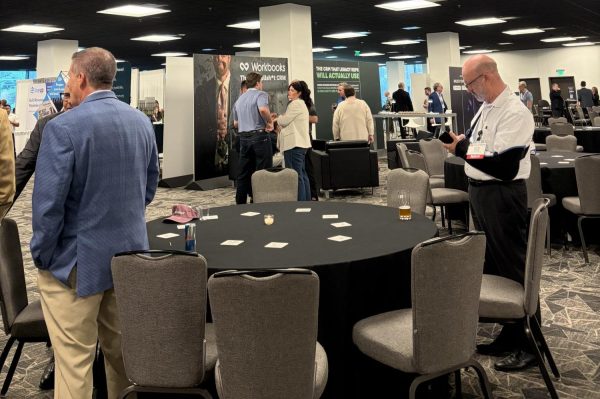


The America’s Newspaper Foundation hosted its annual Mega-Conference from March 30 to April 1 at the Austin Marriott Downtown in Texas.
The Mega Conference allows newspaper industry leaders to connect with one another and work together to shape the future of news. Many of the individuals on the panel suggested emphasis on audience trust, community engagement and sustaining local papers.
While the conference framed itself as a way to boost engagement for local newspapers, the buzzword in almost every panel was “revenue.”
The idea of community seemed to be used as just a drawing point, not something most panelists cared about.
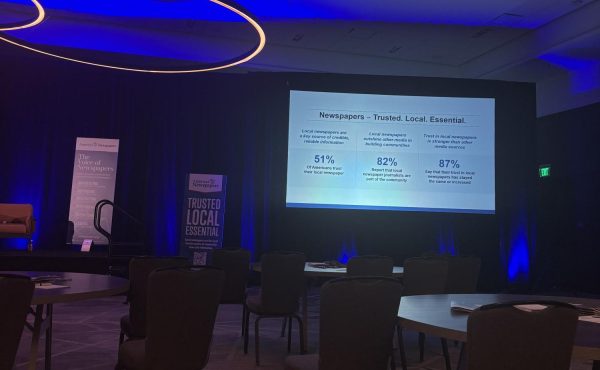
True community engagement within the panels were skipped over from the opening panel: “The Next Era of Local News.”
The only original idea for boosting engagement in a local community during that panel was glanced over due to time management issues. Yvonne Esquibel-Smith from the Nonprofit Fundraiser for Local Journalism was the last to present, with her slides skimmed.
Esquibel-Smith was able to only briefly share the community book club that the foundation hosts to build a relationship with their community. The panel’s only journalism foundation that seemed to care about community happened to be the only nonprofit.
The panels from the event proved to be discouraging for any young, entry-level reporter that may have been in the room. The Ticker was the only collegiate newspaper in attendance.
Many panels praised the use of artificial intelligence, as America’s Newspaper has an entire section of articles dedicated to AI industry news. The praise was not geared toward using it as a tool for journalists, but as a way to cut costs by removing a crucial job function.
One of the opening panels said that they cared about what would get someone to buy its papers, not about what the journalist wanted to report on.
America’s Newspaper defines itself as the “voice for the newspaper industry” on its website, priding itself as a voice “for support, for advocacy, for education, for connection.”
Such values were not expressed toward its youngest readers.
The last panel at the conference featured the highlights of a study conducted by America’s Newspaper and Coda Ventures, titled “The Roadmap Study: What Local Audiences Want Now.”
Coda Ventures President Marianne Grogan presented the study which highlighted four different demographics: baby boomers, Gen X, millennials and women. The study focused on a current demographic age range of 30 to 80.
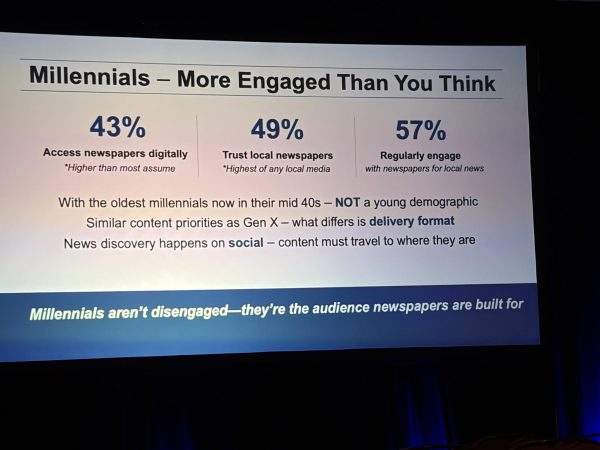
The study forgot one crucial age group: Gen Z, a generation that spans high school juniors, people preparing to enter the workforce and individuals working in professional careers.
When asked by The Ticker why Gen Z was not included in the study, Grogan said it was “because they’re so different.”
Gen Z was raised during the rise of the digital age, mainly through social media, and its members are heavily invested in today’s news.
The American Press Institute found in 2022 that 67% of Gen Z read the news weekly.
With the last panels focusing on what local audiences want, they left out an entire generation, one that is often mocked for being chronically online, but nonetheless consumes news.
Since many Gen Z members receive their news from social media, local outlets must meet them halfway, which is what the study lacked: social media presence.
Fifty-seven percent of X users get their news from the platform, Pew Research Center reported. Around 40% of Gen Z get their news from major platforms such as Instagram, YouTube, Facebook and TikTok.
Gen Z is not alone in receiving news through social media, as 45% of millennials get news from Facebook.
The study instead focused on generations, like boomers who consume most of their news through streaming services.
The study prioritized boomers’ consumption habits over habits of the younger generation who still have years of news-reading ahead.
The study also failed to mention the increasing popularity of podcasts. Pew Research Center found that 67% of Gen Z listened to a podcast in the last year.
Not understanding how a generation consumes news does not mean that generation should be ignored. The future of journalism and consumers is dependent on future generations. To exclude them is to let journalism die.
The study also had a flawed design. It lacked another crucial demographic: men, who are statistically more likely to be sports fans.
Eighty-one percent of American men consider themselves sports fans and 31% of fans engage with sports consumption daily.
By excluding men, the study disproportionately concluded what local news outlets should focus on.
While the study claimed that women are the head of the household who decide where money is spent, it forgot that the number of single adults is increasing.
Only 51% of U.S. adults are married, a 6% decline from 1990. More men are the head of their own house, buying, reading and watching what they want.
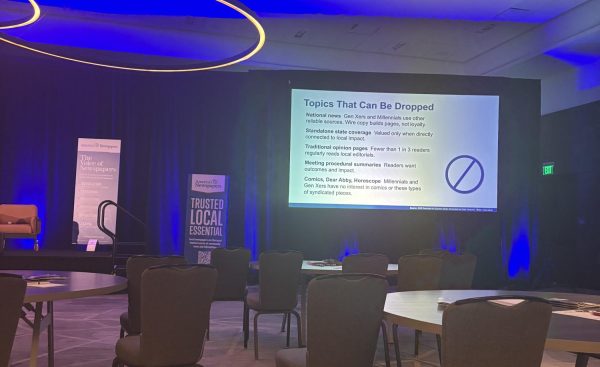
The study also spoke against publishing editorials — claiming only a third of consumers read them — but praised adding recipes, as 30% of readers wanted them.
Using women as a demographic was a discreet way to include sexism into an already male-dominated field. These findings insinuated women only read a newspaper for soft news like recipes and health, not hard news.
This study was not about news consumption or expanding coverage to meet the needs of a community. Just like the rest of the conference, it was about money. Some news outlets refuse to post on social media because they lock content exclusively behind a paywall.
Nearly 3,500 local papers have closed nationwide since 2005, 136 of which closed in 2025 alone. At risk of closing down, local papers must start looking at the future.
The Roadmap Study had a perfect opportunity to study the future news audience, but instead stuck to older audiences, forgetting that Gen Z is the current demographic they must appeal to.
If local papers continue to refuse to understand the new generation and its news intake habits, more papers will continue to close and conferences like Mega will no longer need to fill rooms with executives to discuss revenue flows.