

Reuters published a lengthy article on March 13 documenting its efforts to investigate and ultimately uncover the identity of the enigmatic artist known as Banksy.
Banksy has numerous works attributed to him, like the painting “Girl with Balloon,” which was voted the favorite piece of artwork to have come out of the U.K. It famously self-destructed after being sold at a Sotheby’s auction for $1.4 million.
Banksy pieces seemingly appear out of nowhere, often done overnight with no witnesses, with works authenticated by his company, Pest Control Office.
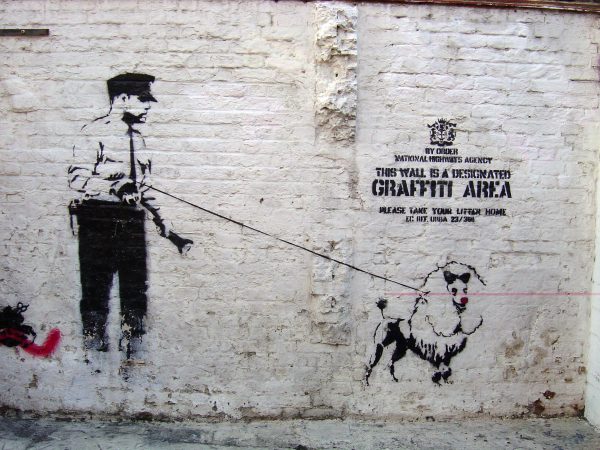
Banksy is known for incorporating the political atmosphere into his art. Many of his pieces take the form of vandalism of public property and depict anti-authoritarian themes.
In September 2025, an exterior wall of the Royal Courts of Justice in London was vandalized with a piece depicting a judge beating a bloodied protester with his gavel. It appeared just a day after 900 people were arrested at a pro-Palestine protest. An attempt was made to scrub the mural off the walls, which only left behind an eerie shadow of the work.
Mark Stephens, Banksy’s long-term lawyer, said that revealing Banksy’s identity would put the artist at risk as well as harm the public interest.
Working “anonymously or under a pseudonym serves vital societal interests,” Stephens wrote to Reuters. “It protects freedom of expression by allowing creators to speak truth to power without fear of retaliation, censorship or persecution – particularly when addressing sensitive issues such as politics, religion or social justice.”
Reuters said it took into account Banksy’s privacy claims and the wishes of many of his fans for his identity to remain a mystery but decided that the decision to reveal his identity took precedence.
The investigation validated a previous report published in 2008 by the British tabloid “The Mail on Sunday.” The publication stopped just short of confirming that a man from Bristol named Robin Gunningham was “believed to be Banksy.”
According to Reuters, The Mail on Sunday’s belief were correct; Reuters seemingly confirmed Gunningham’s identity by finding his name attached to a previously unreleased New York City Police Department report involving his arrest for vandalizing a Manhattan billboard.
However, there was no trace of the name Robin Gunningham in U.K. public records.
The lack of additional records on the name, as well as statements made by Banksy’s former manager, Steve Lazarides, led Reuters to conclude that Banksy had legally changed his name.
Drawing connections between known relationships and the official record of a border crossing into Ukraine that coincided with the increased works by Banksy, the new name of the artist was revealed. Alongside Robert Del Naja, frontman of the trip-hop group Massive Attack with known ties to Banksy, there was another name on the document: David Jones.
The source that provided the record of the border crossing to Reuters also gave the birth date on the passport provided by Jones, which matched that of Robert Gunningham. Stephens said Banksy “does not accept that many of the details within [the] enquiry are correct.”
Banksy has not posted anything about the apparent unmasking on social media or through his company to confirm or deny his identity. However, his website addressing the question of who the artist truly is said, “Does it really matter?”
It is unclear if Banksy is in danger of being prosecuted for his crimes without the benefit of anonymity. In cases where graffiti is confirmed to be his work, it does not seem that he is penalized despite being a known entity. Stephens noted that some building owners are happy to find their wall defaced by Banksy, hoping to profit from the work.