

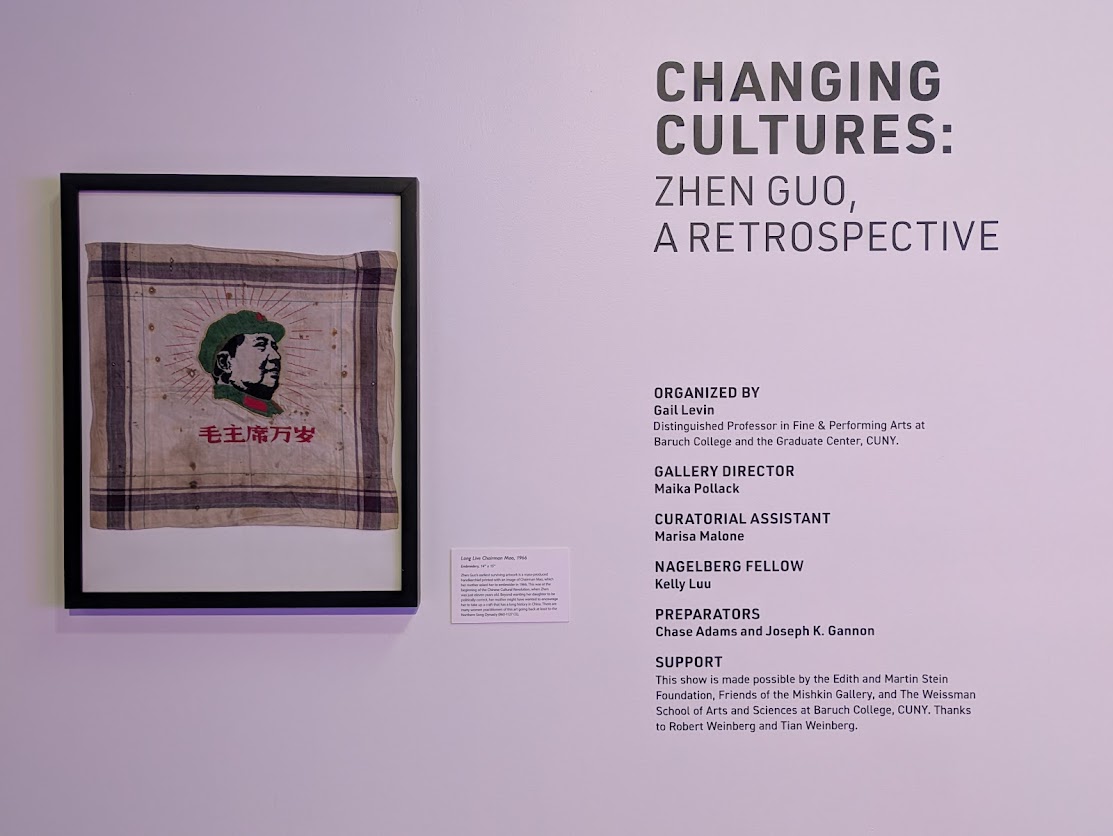
Baruch College’s Mishkin Gallery opened its newest exhibit, “Changing Cultures: A Retrospective” on March 12, and will remain accessible through June 12. The artist, Zhen Guo, is responsible for the work featured in the gallery. Guo grew up in Shandong, China and moved to the U.S. in 1986. Guo describes her experience as an immigrant as one of jointness, not rivalry, stating, “I learned about the world in China, and confronted it in the United States.”
As a young girl, Guo was sent away to learn how to sew and refined the craft enough to be one of only two women who were selected to attend the Zhejiang Academy of Fine Arts in September of 1978.
Despite her father’s worries about art being an unsteady career path, she went forward with art, rejecting her dad’s plea to obtain a steady and respectable career in the sciences. After her graduation in 1982, she decided to further her studies of art in the U.S. at the San Francisco Art College in 1986.
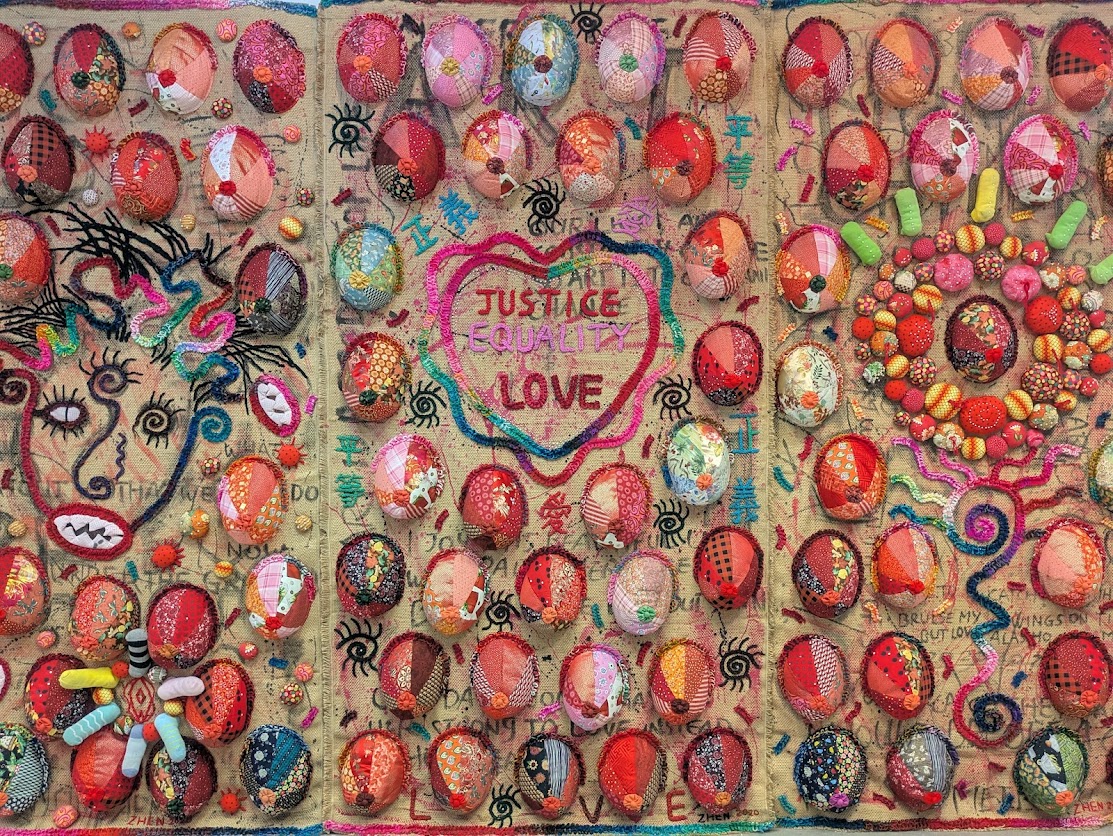
Guo’s artwork reflects her Chinese upbringing and her American life. On a 73” x 53.5” canvas, she makes use of pearls, tufted yarn and her sewing skills to make a portrait of admirable women imitating the Hindu goddess Kali by having their tongues sticking out of their mouths.
Sojourner Truth, the Guerrilla Girls, Justice Ruth Bader Ginsburg and Qiu Jin are some of the notable women included in the 2025 “We are All Kali” piece. Guo has several works inspired by Kali, presumably because Kali is described as being a spiritual representation of female power in Hinduism and Guo focuses on contemporary female art.
Women and feminism are recurring themes in Guo’s work. Guo views the female breast as a symbol of motherhood and sensitivity. Her 1980 “Mother’s Love” rice paper and ink work shows two women breastfeeding their sons in front of a hen and its six chicks. Guo connects women with nature to illustrate the integral part females in every form play in the creation of life.
Just as she believes women are great creators of life, Guo believes women are victims of life systems, particularly the patriarchy.
Toward the very end, guests at the Mishkin Gallery can see colorful breasts attached to punching bags. Guo claimed that she views boxing as a representation of toxic masculinity, but she never expanded on what informed her opinion.
Gallery Manager and Curatorial Assistant Marisa Malone told The Ticker that the choice was made to assign a visual that highlights the absurdness of how living with the patriarchy goes directly against humanity. The dangerous, risky and rough nature of contact sports such as boxing ends lives through traumatic brain injuries. In contrast, breasts are sensitive, nurture human lives and provide security and safety.
“New York City is a multicultural city, attracting people from all over because of its big art scene,” Malone said.
Like all universities, Baruch hopes to foster students who are interested. Malone recommended curious Baruch students speak to Gail Levin — an art history professor at Baruch — for more information on the exhibit to learn about Guo thoroughly.
Malone insisted that over the generations, cultures and even subcultures change, and learning about changing cultures makes all the difference.