
If “VisionQuest” proved anything, it was that Doctor Strange, played by Benedict Cumberbatch,
was wrong in the Multiverse of Madness movie when he told Wanda Maximoff, played by Elizabeth Olsen, that her children from the Hex were not real.
“VisionQuest” is the third and final installment of the “Wanda- Vision” trilogy. The series follows White Vision, who was last seen in “Wandavision” sent as a weapon to kill Wanda after he left WestView when the hex Vision had bypassed his protocols.
All three limited series, which included “Agatha All Along,” featured some sort of fake reality.
Wanda created a fake hex where she and Vision could be a family in the first series, one of their sons turned a fictionalized witches’ road into reality, and finally, viewers literally got into White Vision’s mind via a mindspace full of different Marvel artificial intelligences.
Fans got to meet the humanized avatars of known Tony Stark AI’s such as J.A.R.V.I.S., F.R.I.D.A.Y., E.D.I.T.H., DUM-E and U. Each AI serves as part of White Vision’s household, where each has a different function and distinct personality.
Living in the mindspace house attic is Ultron, an Artificial General Intelligence that The Vision had spared despite Ultron trying to eliminate all of humanity, viewing them as their own greatest destruction.
While White Vision deals with the idea of complicated potential fatherhood to the supposed son hex Vision had with Wanda, who managed to bring his consciousness into another person after the hex closed, Ultron raves about craving freedom from White Vision’s world and, in a strange twist, feeling a sense of humanity.
While trapped in the attic, Ultron commonly referenced Pinocchio, as he wanted to be like a “real boy” and freed from his technological “strings.” Ultron’s obsession with humanity was hinted at in a pop-up event that was held in New York City prior to the series premiere.
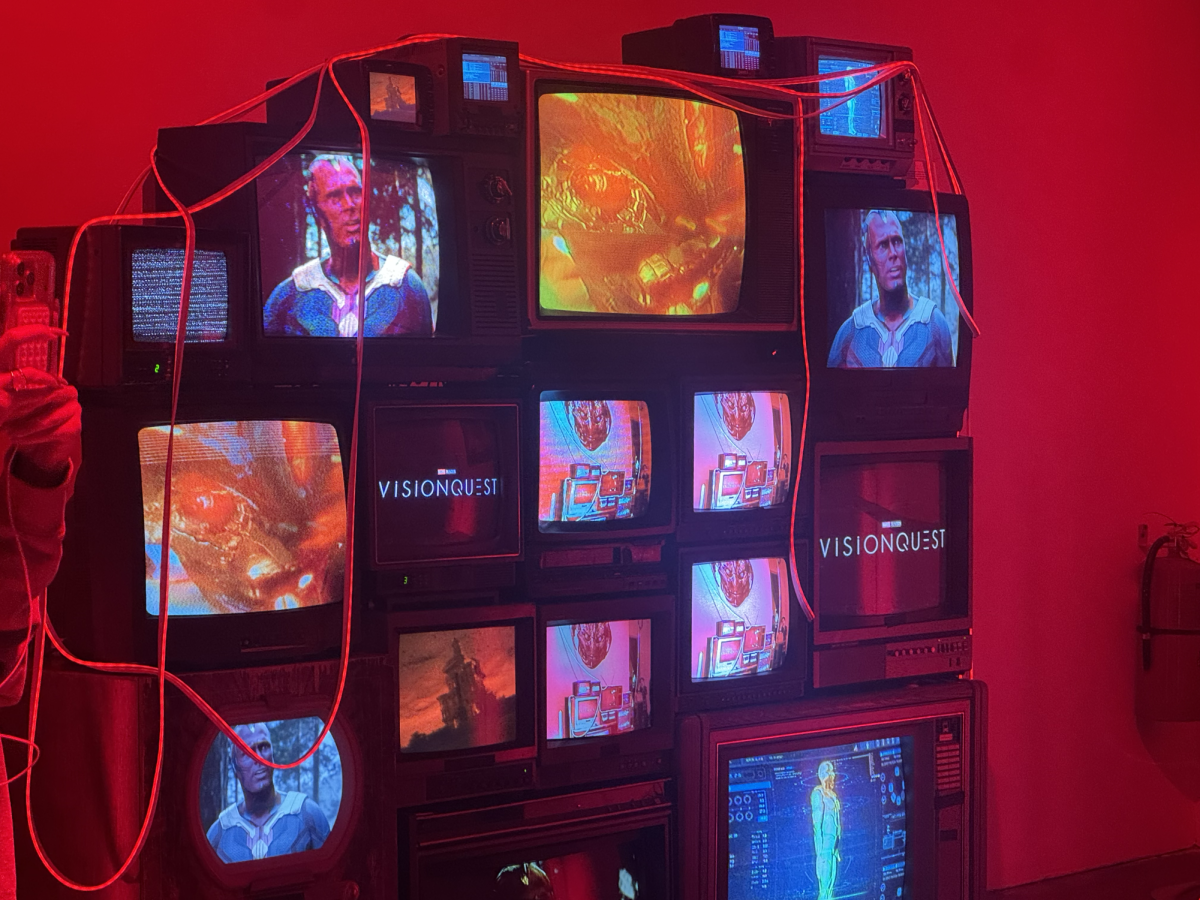
The “Controlled, Altered, Deleted” pop-up featured famous works of art, reimagined to coincide with Vision. “The Creation of Adam” was restructured to “The Creation of Vision,” where Vision and Ultron respectively replaced Adam and God, while Iron Man and The Hulk stepped in for the angels.
“Saturn Devouring his Son” was also restructured to “Ultron Devouring his Son,” Vision. Aside from the real movie props such as their New Jersey property deed and the exclusive trailer shown, Wanda only appears once.
“The Meeting on the WestView Stairs,” a restructured painting of “The Meeting on the Turret Stairs,” is a depiction of a doomed lover’s final goodbye.
However, as both Wanda and Vision put it, “We have said goodbye before, so it stands to reason we’ll say hello again.” All of the reimagined art was created by commissioned artists.
Despite Vision’s character being an AI, all artwork and set work was fully imagined by humans and, in fact, used AI’s discrepancies as a point of reference when creating Vision’s mindspace. To coincide with the sense of humanity Vision lost and the humanity Ultron strived to gain, the
collection let guests “enter Vision’s mind and join him in parsing his memories and his legacy through the ultimate human lens: art.”
If “WandaVision” was love, “Agatha All Along” was grief and “VisionQuest” was certainly an ode to perseverance.
“VisionQuest” brought the whole family back together, minus one.