

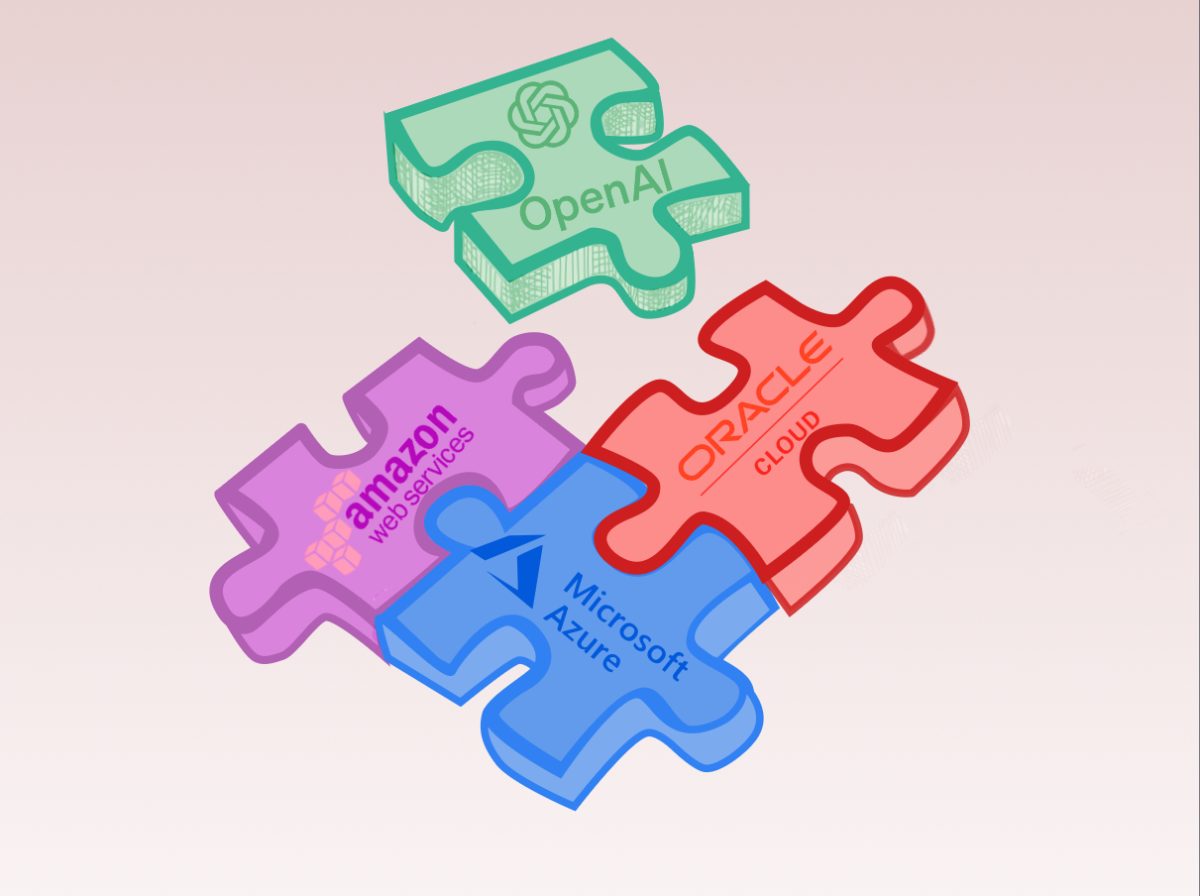
In the past, OpenAI was known for collaborating solely with Microsoft for cloud computing.
However, the contract was recently renegotiated to allow it to purchase services from any cloud computing company even without Microsoft’s approval.
This signals a stark shift from single-cloud sourcing for Artificial Intelligence workloads to a multi-cloud approach.
Sam Altman, CEO of OpenAI, has complained that OpenAI struggles from “severe computing shortages” and being constrained in model training and product launches.
OpenAI is transitioning into a new era of cloud infrastructure through partnerships with Oracle, Google and Amazon, with $300 billion committed to Oracle and $38 billion to Amazon.
OpenAI is showing that access to high-performance GPUs is a scarce resource that requires long-term capital investment.
This highlights the interference that occurs when multiple AI workloads run on the same hardware, which creates delays and inconsistent speed.
Cloud infrastructure is an asset that ensures competitive advantage and resilience in the digital economy.
AWS is currently the industry’s largest cloud provider, but it faces strong competition from Microsoft and Google in the AI market and is highlighting its capabilities, claiming its system supports over 500,000 chips.
AWS is using purpose-built EC2 UltraClusters, which link GPUs over low-latency networking that allows for the large-scale training demands of OpenAI.
While OpenAI benefits from AWS’s performance, scale and security, the partnership also helps scale OpenAI’s agentic AI systems, which can complete tasks automatically.
Currently, the usage is limited to Nvidia chips, so OpenAI plans to run workloads on AWS infrastructure and tap into hundreds of Nvidia’s GPUs in the U.S.
Some headwinds OpenAI is facing are profit generation and the early stage limitations of AI technology.
To counteract this, partnerships allow OpenAI to have a safeguard to maintain consistent performance and innovation.
They allow OpenAI to navigate problems such as cloud downtimes to ensure continuous access to its services providing OpenAI the financial flexibility to leverage the strength of certain cloud providers given the circumstance.
This fosters competitive pressure among companies that OpenAI partners with, driving further innovation. This leads to stronger security measures, faster processing speeds and more efficient data management.
It can be thought of as a symbiotic relationship: each provider innovates while OpenAI accesses key technologies to develop more sophisticated and efficient AI systems.
This allows OpenAI to have operational resilience, allowing it to adapt swiftly to technological shifts and market changes.OpenAI’s plans will lead to more investments in infrastructure that support its long-term objectives, blending technology with strategic financial management.
As digital economies are pivoting to AI-driven solutions, OpenAI could be at the forefront to have a say and form the evolving modern world.
There can also be economic benefits. This deal can support innovation, economic growth and job creation. Competition among cloud providers for a larger share of OpenAI’s spending can affect non-tech sectors such as healthcare, finance and manufacturing.
It is an example of how critical of a role cloud infrastructure will play in the evolution of digital economies.
With OpenAI setting the precedent of a multi-cloud approach, other organizations may follow suit, which ultimately bolsters compatibility and allows for seamless integration.
Categories:
OpenAI collaborates with multiple cloud providers
November 24, 2025
More to Discover