
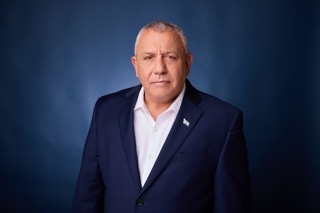
Israeli President Isaac Herzog chose opposition leader Gadi Eisenkot to form the next government, passing over Prime Minister Benjamin Netanyahu after the country’s Oct. 27 election. Herzog formally handed Eisenkot the mandate at the president’s residence in Jerusalem on Nov. 8.
Parties holding 67 of the Knesset’s, Israel’s legislature, 120 seats endorsed Eisenkot, who leads the Yashar party. His support came from a four-party opposition bloc who won 48 seats, along with the Arab-led Ra’am and the Joint List coalition, which hold 19 seats between them.
Netanyahu drew 46 endorsements, though his Likud party remains the largest in the Knesset, with 27 seats.
Those endorsements are not the same as a governing majority, and several members of the Jewish-led bloc have said they will not join a government that relies on the Arab parties’ support.
Eisenkot has until Dec. 6 to build a coalition, with a possible 14-day extension. If he fails, Herzog can give another lawmaker a chance, and if that attempt also fails, the Knesset can back a third candidate by majority. If no candidate receives backing, a new election must be held within 90 days.
At the ceremony, Eisenkot promised to establish a “national emergency government” that “will require creative and unconventional political acts.”
He said that “Israel does not have the privilege of wasting time or repeating endless rounds of elections” and told the parties that “all of [them] will need to compromise.”
Herzog said, “The State of Israel needs a stable government” and urged Eisenkot to establish a government that “will serve the entire people.”
Just before Herzog announced his choice, Netanyahu released a video calling for a “national unity government” and warned against “hastily swearing in a government with terrorist supporters,” referring to the Arab-led parties, according to The Associated Press.
Netanyahu has also challenged parts of the election results as suspected voting irregularities were investigated. Israel’s Central Elections Committee said the vote’s integrity was not compromised.
Talks have moved quickly since. On Nov. 9, Eisenkot and Avigdor Liberman, who leads the Yisrael Beytenu party, reportedly agreed that the next Knesset speaker should come from the Yashar party and that the Eisenkot-led opposition should reach out to the ultra-Orthodox parties.
The two still need to discuss with the bloc’s other leaders, Naftali Bennett and Yair Golan, before making an announcement.
The new Knesset was sworn in on Nov. 10. Netanyahu used his speech to push again for a national unity government, pointing to the threat of Iran’s nuclear program. Eisenkot then canceled a planned meeting with Likud representatives, calling the speech “delusional, divisive, hateful, and disgraceful.”
“Netanyahu does not want unity,” Eisenkot’s party said.
The Likud party said it “is willing to meet with representatives of any faction that desires unity.”