
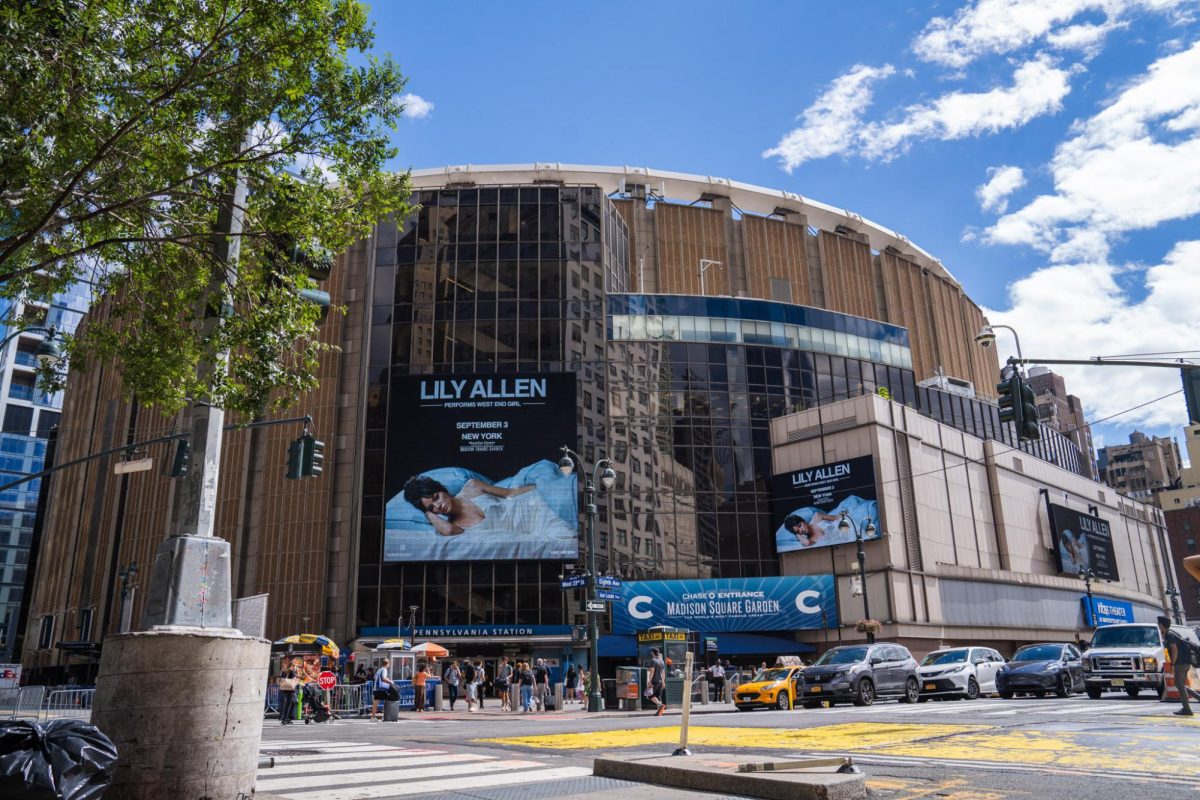
Demonstrators gathered outside Madison Square Garden on Aug. 14 to demand a ban on the venue’s use of facial recognition technology. They argued the surveillance tool violates customers’ privacy and opens the door to discrimination and abuse.
The rally was organized in part by the digital rights group Fight for the Future. It targeted owner of the Garden James Dolan, who has used facial recognition to track visitors and deny entry to attorneys involved in litigation against the venue.
Fight for the Future director Evan Greer said Dolan’s system amounts to a “surveillance empire that rivals some nation states.” She added that fewer rules govern its use than government surveillance.
Speakers pointed to specific incidents to argue the risks are not hypothetical. They cited a cyberattack this summer that exposed MSG visitor data, including emails, full names and street addresses.
They also referenced a 2022 case in which a mother chaperoning a Girl Scout troop was turned away from Radio City Music Hall, another Dolan-owned venue, because she worked at a law firm suing the company.
Council Member Shahana Hanif, a Brooklyn Democrat, raised the possibility that leaked biometric data could reach federal immigration authorities. She acknowledged that scenario remains theoretical.
During the rally, Hanif, the bill’s prime sponsor, spoke on “Ban the Scan,” a City Council bill that would bar businesses open to the public from using biometric scans to identify or verify customers including sports arenas, concerts venues and stores.
The bill would prohibit selling or sharing biometric data with third parties. It would also let customers sue for violations, with damages of up to $5,000 per intentional or reckless breach.
Hanif announced at the rally that the bill now has the backing of Mayor Zohran Mamdani’s administration. It also has 28 co-sponsors on the 51-member City Council, which is the majority of the Council.
Consumer and Worker Protection Commissioner Samuel Levine spoke in support of the measure.
“This kind of mass surveillance opens the door to abuse and discrimination, making consumers in our city uniquely vulnerable,” he said.
A companion bill from Council member Pierina Sanchez would further restrict how biometric data can be sold or shared. It has not yet secured majority support or Levine’s backing.
The legislation still needs the endorsement of Council Speaker Julie Menin, who has not taken a position. Hanif said she is in talks with Menin’s office.
Madison Square Garden has defended its use of the technology as a safety measure. In an unsigned statement, a spokesperson said people “have been recognizing each other’s face since the beginning of time,” and that the system simply automates that process electronically.
The Garden also noted that signage disclosing the technology’s use is posted outside the venue, as required by law.
No vote on the bill has been scheduled.