
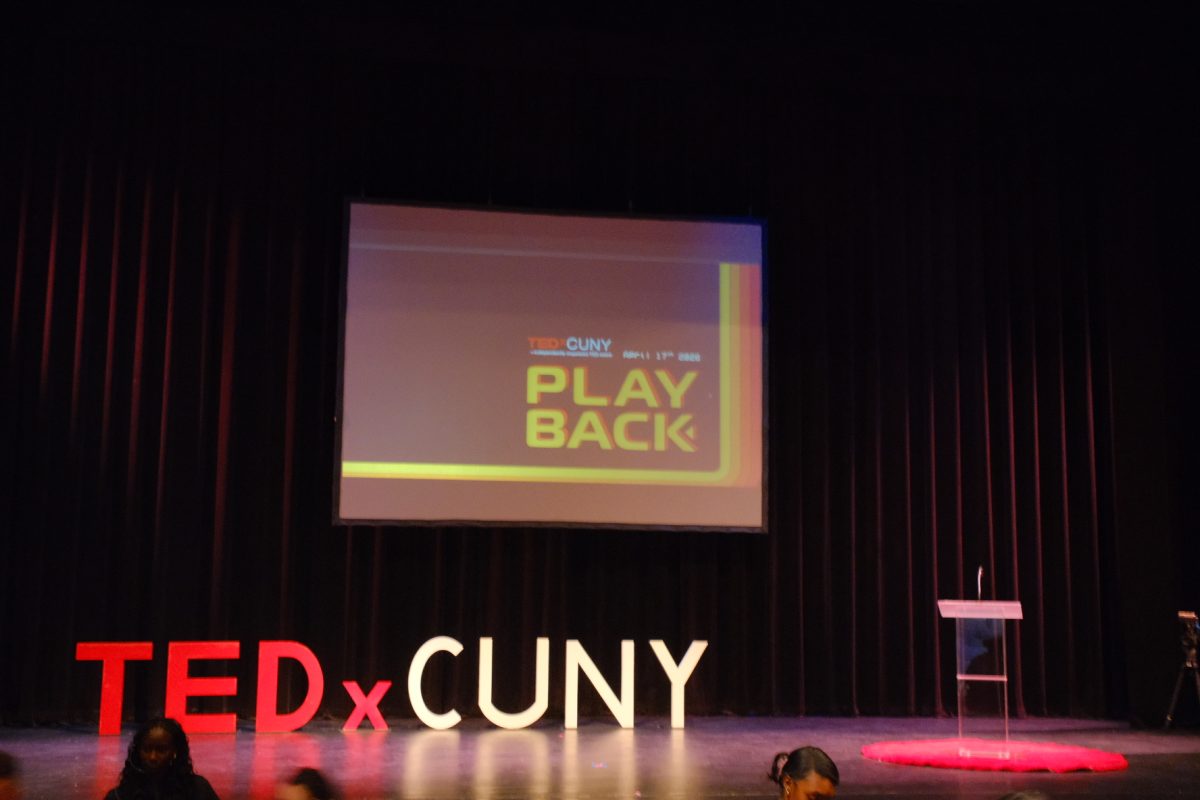
The TedxCUNY conference took place on April 17 at the Gerald W. Lynch Theater at John Jay College of Criminal Justice, bringing together students, educators and professionals from across New York City to share ideas and engage in meaningful discussions.
This year’s “Playback” theme encouraged the audience to reflect on their past experiences and consider how these moments can inspire new perspectives that shape discovery, insight and even the future.
Between sessions, attendees relaxed with different workshops such as a scribble art workshop, an NYC aromatica station and a recess grove watercolor activity.
Dara Bern, the Dean of Macaulay Honors College, started her talk with a confession: She rewatches the same movies over and over again. She mentioned “The Devil Wears Prada,” “Pretty Woman” and every single Marvel film.
Her point wasn’t really about movies; every time she goes back, she catches something she missed.
“A line hits differently,” she mentioned. Previously, a character she had ignored suddenly becomes the most interesting one in the story. “The movie has not changed, but I have.”
She grew up in the Caribbean, where when at a party, when the DJ plays something really good, the crowd yells to play it back or “bo selecta.” They do this not because they didn’t hear it the first time, but because they want to feel it again.
To end, she said the proverbs — “until the lion tells the story, the tale of the hunt will always glorify the hunter. Playback is how we begin to hear the lion.”
Rev. Moose didn’t plan to become a political activist. However, when the pandemic hit and 90% of America’s independent music venues were at risk of closing permanently, he ended up lobbying Congress at Washington, DC.
He had already built a quiet national network of venue owners through Independent Venue Week. When the pandemic hit, the network had something traditional lobbyists didn’t have: over 100 million email contacts across nearly every congressional district.
Their strategy was “find out which lawmakers you need, learn their favorite artists and get those artists on the phone with them.”
It worked. The Save Our Stages Act passed and became the largest arts funding program in American history. However, he wasn’t there just to celebrate. One company now controls most major concert venues.
“All music is local,” he said, and currently, local is losing ground. Andre Perez, a doctoral candidate and CUNY educator, opened with a moment from his 2020 classroom that he never forgot.
A student named Derek, who grew up near where George Floyd was killed, asked him why he hated all white people. Perez responded by writing two words on the board: “white” and “White,” asking the class to figure out the difference themselves.
Building upon the broader themes of lived experiences, Dave Steck, a filmmaker and part-time professor at Hunter College, focused on the creative process, reflecting on how creativity is rooted in memory and lived experiences.
“Creativity is based on memory,” Steck said in an interview with The Ticker. “We store impressions, experiences and emotions, and when we create something new, we recall those and put them in a different order.” Steck explained that preparing for the conference became a much more involved process than he originally expected.
Over the course of a few months, he went through over 10 drafts, working with student organizers to reshape his talk into something the audience could better connect to.
“I wrote something that should be published, not something that should be said,” Steck said. However, despite the immense preparation, Steck noted that he didn’t regret following through with his talk.
“I didn’t know that I was going to want to be here so much, and I don’t think I knew that until I walked off that stage,” Steck said.
The experience gave him a new appreciation for the storytelling behind these talks and allowed him to step outside his comfort zone, especially as a filmmaker who is often behind the camera.
Dr. Sultan Jenkins, a tenured associate professor in the natural sciences department at Laguardia Community College, focused on presence, specifically how presence and perception affect connection and what it means to be seen or unseen.
He tailored his discussion around his own lived experiences with racial stereotypes and how they show up in the classroom with students. He also focused on empowering students and others who, like him, may show up in spaces that weren’t built with them in mind.
“Twenty years ago I wouldn’t have done a Ted talk,” Sultan told The Ticker. “But I know the only way to grow is to get out of your comfort zone every now and then, to do things that you normally would not do.”
Sultan also said that it was a process in coming to discern and address microaggressions.
“For some people, it’s easier to speak out, but I had to learn it, but also learn to do it the right way,” Sultan said. “Somewhere along the way a switch flipped, and I was like no, this ain’t right and if I stay quiet, it’s only going to continue.”
Sultan also shared that doing a TEDtalk was something that has always been on his bucket list, even though he felt like it was re- served for someone of a different status.
“Everyone has a story and everyone has value,” he said. “The only way to find your value is to get out, get out of your bubble, get out of your comfort zone, and expose yourself to new things. Yes, it’s difficult to do, but once you break through, it becomes a whole lot easier.”
“Now having done this, I feel like a weight has been lifted off my shoulders and I can accomplish anything,” he continued. “I don’t have fear anymore, it’s very liberating. I tell students, it’s okay, give yourself grace, give yourself some time and you’ll get there.”