
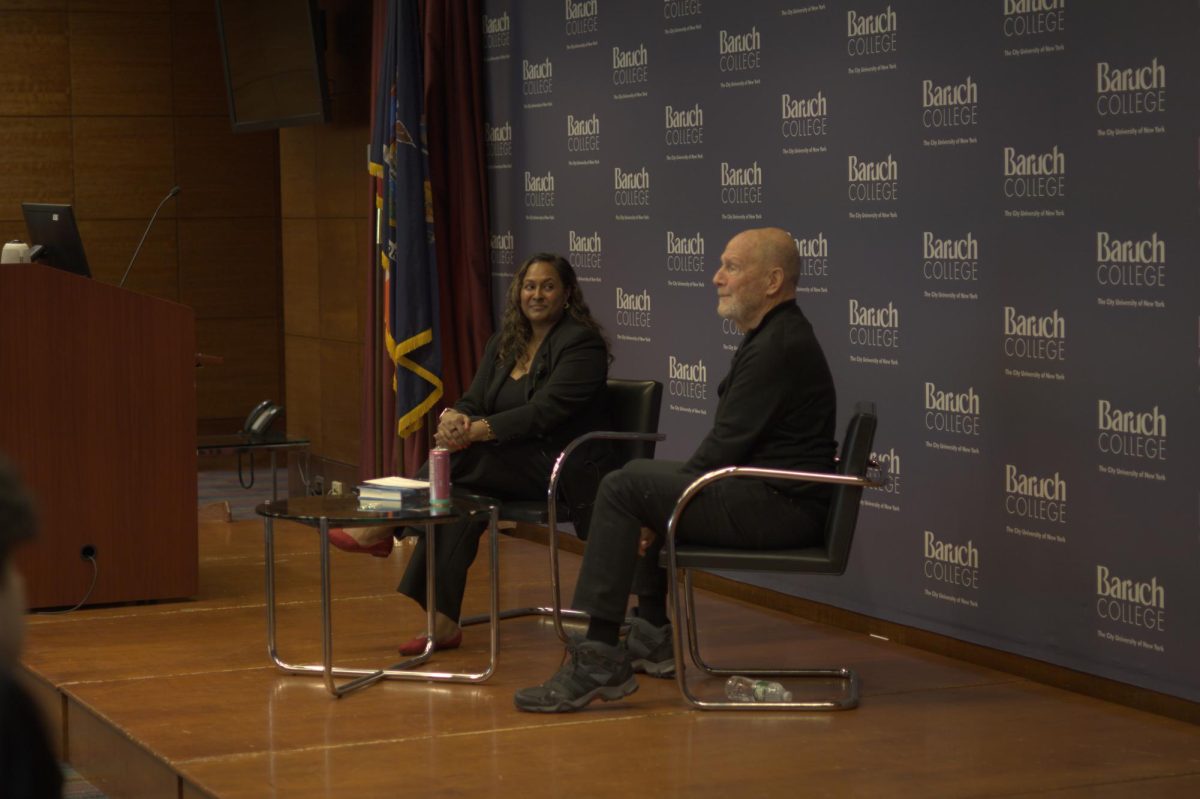
Lew Frankfort, the former CEO of Coach Inc., spoke to Baruch College students at an event jointly hosted by the Lawrence N. Field Center for Entrepreneurship and the Zicklin Center for Corporate Integrity on Feb. 5.
Coach, a luxury goods brand valued today at $8.5 billion, was counting just $6 million in annual sales when Frankfort joined in 1979 as vice president of new business development. His 35-year tenure at the company would lead Coach to become one of America’s largest luxury handbag brands, particularly catered to middle-class women.
“Bag Man,” Frankfort’s recent memoir, reflects on the role and journey of creativity in shaping his leadership. “I began to form a romantic if idealistic notion of Coach as a microcosm of traits I liked most about America: authenticity, aspiration, individuality, invention,” Frankfort wrote in his memoir, which he distributed to Baruch students during the event.
Frankfort’s perspective was shaped long before he entered the fashion industry. The son of a Bronx policeman and an alum of New York City public schools, Frankfort attended Hunter College and then Columbia Business 6chool before landing a job as the director of the NY& Agency for Child Development under former mayor John Lindsay.
He had no previous fashion experience when designer 0iles Cahn, the founder of Coach, asked him to step in as CEO in 1995. In leading Coach, Frankfort quickly identified himself with the gritty craftsmanship that made the brand’s handbags a staple of the American wardrobe.
Coach’s retail strategy changed in favor of a direct relationship with customers. The company opened a flagship location on Madison Avenue, introduced an online site before competitors like Gucci and Louis Vuitton and expanded to Japan and China.
Reflecting on his career, Frankfort credited a philosophy of “magic plus logic” for the brand’s success.
“Curiosity is not a logical thing, it is a magical thing,” Frankfort told the audience.
For Coach, a combination of data and intuition led to the reinvention of glove-tanned leather styles, introduction seasonal color palettes and resurrection of archival handbag designs from the 1960s.
Frankfort aimed to create a brand specifically for the middle class, meaning the brand had to remain affordable and timeless. It had to be “egalitarian,” Frankfort said, comparing Coach’s vision to the opposite business models of high-end brands like Louis Vuitton.
“When I thought about what Coach could be one day, I thought of the concept of a democratized luxury brand, a brand that would be affordable to 40 or 50% of America,” Frankfort said.
By the 1980s, Coach was becoming a major retail brand and began selling its leather goods at department stores like Macy’s, Bloomingdales and Nordstrom. In 1985, Coach was acquired by Sara Lee Corp., a frozen and baked goods company, for $30 million.
Despite the odd pairing of the companies, Coach grew rapidly. Net sales climbed at an average annual rate of about 32%, rising from $19 million at the time of acquisition to $540 million by 1997.
However, sales began to decline in 1998 as consumer preferences shifted toward mixed leather and non-leather goods. Sara Lee began focusing more on its food business, bringing Coach closer to operating independently.
This led to Coach’s initial public offering in October 2000 at $16 per share and closed the first day of trading with a $861 million market cap.
With the IPO, Coach gave an equity grant to every single employee, which developed into a permanent program. Frankfort said it was among the many decisions Coach made “on behalf of [their] employees,” without informing Sara Lee.
“I never had to compromise my values at Coach. I had to negotiate,” Frankfort said about operating under Sara Lee. “When we had a parent company, I kept from them and did what I thought was right. Other times, I confronted them.”
Frankfort retired from Coach in 2014, ending a 35-year tenure marked by efforts to revitalize and expand the brand. In the years that followed, Coach underwent a significant rebrand that repositioned the company to better align with popular trends followed by Generation Z and millennial consumers.
Frankfort emphasized that Coach’s consumer focus and its decades-long effort to build its reputation were the result of hands-on leadership, decisions that ultimately moved the brand forward.
“We feel that we’re stewards of the brand,” Frankfort said. “We don’t own the Coach brand. It belongs to everyone, the investors, the customers, the employees, the communities.”