

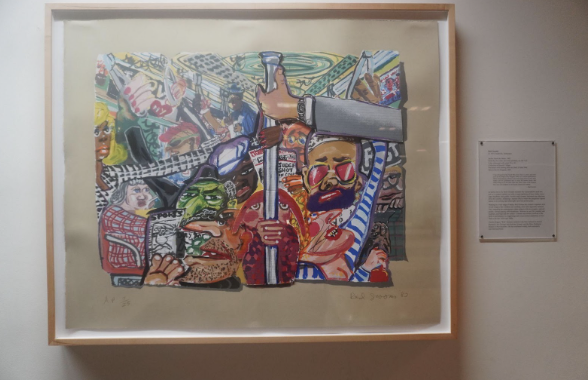
Nashville-born artist Red Grooms painted “Masters at the Met,” in 2002, an artwork depicting a group of cartoonish New Yorkers exploring the Metropolitan Museum of Art.
Currently the painting is displayed on the 8th floor of the Newman Vertical Campus. It was purchased by Baruch College with funding from the State of New York’s “Percent for Art Program” in 2003.
This program was first created in Philadelphia in 1959. It required all newly built public buildings to spend at least 1% of their budget on art.
Baruch’s collection often reveals how American art and its market have responded to social changes. This tradition continues today in the Mishkin Gallery, Baruch’s art museum.
“Those acquisitions for the [program] occurred later than important foundational gifts by donors, and the university continues to accept gifts of select artworks from donors, many of them alumni of the college,” Maika Pollack, the director of the Mishkin Gallery, told The Ticker.
When selecting artwork, “The university aims to answer a series of questions: its relevance to the university mission and community, the reputational impact, and any costs or risks of accepting the gift.”
In the business school context, Baruch’s collection empowers students to become better consumers of digital media.
“We live in a hyperactive information economy where we are bombarded by content, in an environment where meaning can easily be overlooked or taken for granted,” Spencer Everett, an adjunct lecturer teaching English in the Weissman School of Arts and Sciences, said.
Everett’s classes, although focused on literature, often prompt students to interpret visuals in their writing, including those by experimentalist Andrea Zittel.
“The ethical values that I want to instill in the classroom intersect with the values of the arts: independent spirit and self-determination, intuitive thinking and acting,” Everett said.
In years past, Baruch hosted a “Reframing America” initiative that encouraged students to explore the college’s art collection in their English classes.
Today, Maika Pollack, the Mishkin Gallery’s new director, wants to make the collection more accessible to students.
“I’m interested in developing grant-funded initiatives to improve how art is displayed on campus and better curate the collection, particularly in public spaces,” Pollack said.
Ultimately, Baruch’s art collection, just like its classes, prompts students to explore their own identities in a busy and ever-changing megacity.
“I want to make art that is challenging, not safe,” Zhen Guo said, reflecting on her exhibition at the Mishkin Gallery. “Art that raises questions and makes people think and speaks in my own unique voice.”