
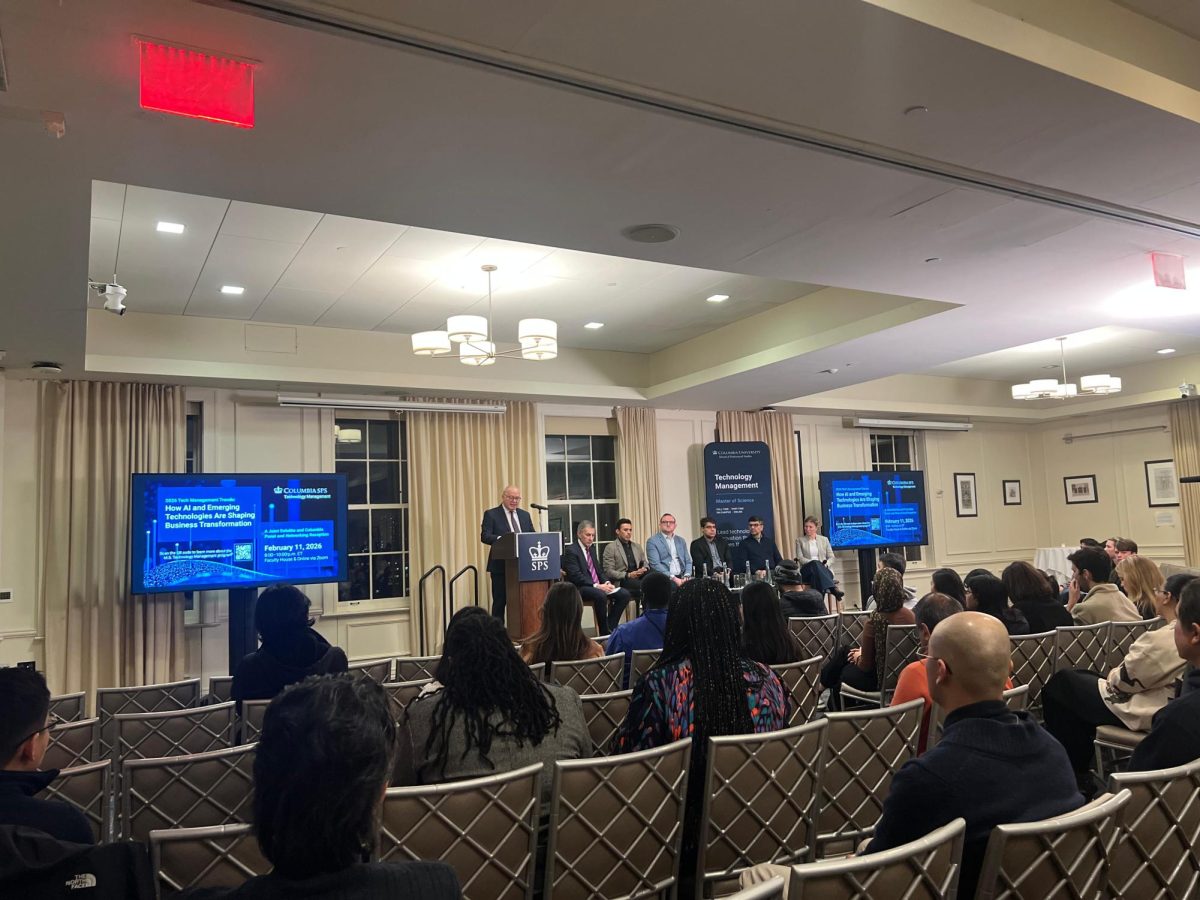
Columbia University’s Technology Management program hosted a panel on Feb. 11 in collaboration with Deloitte to talk about artificial intelligence and its direction.
The conversation was moderated by Program Director for the MS in Technology Management program and Professor Shahryar Shaghaghi and featured Deloitte partners Lindsey Berckman, Joydeep Mukherjee, Ashish Midha and Juan Tello.
One of the first topics was “AI goes physical,” exploring how AI is moving beyond chatbots into factories, warehouses and robotics.
Berckman, who works at the intersection of technology and supply chains, said that while robotics continues to advance, many manufacturing facilities still rely on older systems.
“If you walk into any U.S. manufacturer today, they don’t all look like they do on TV,” Berckman said. “They still have assets from the ’70s that aren’t fully connected.”
Mukherjee noted that companies initially rushed to apply AI broadly, often without clearly defining the problem first.
“A lot of organizations were throwing AI solutions at problems,” Mukherjee said. “Now we’re seeing more thoughtful conversations about what the actual problem is.”
Midha said the pace of development is accelerating, adding that “organizations still have to think about how they implement them properly.”
The panelists were also asked how companies measure success, with questions ranging from “What’s the return on investment?” to “What new opportunities can this create?”
Tello emphasized that companies may be focusing on the wrong metric. “It’s not just about ROI,” Tello said. “It’s about return on opportunity. Are you creating new capabilities faster?”
The panel also acknowledged that many students worry about AI eliminating entry-level roles. The speakers pushed back on that concern.
“The analyst role isn’t disappearing,” Midha said. “But the expectation shifts.”
Repetitive tasks may shrink but expectations will rise, with new hires expected to think critically, interpret AI outputs and connect insights to decisions.
Berckman also stressed that simply knowing how to use AI tools will soon be expected.
“Being fluent in this technology is going to be non-negotiable,” she said. “But context and judgment still matter.”
Cybersecurity was the next topic.
AI can strengthen defense systems, but it also gives attackers new tools. Tello noted that organizations must remain vigilant as systems become more connected.
“We’re increasing the surface area,” Tello said, referring to expanding digital infrastructure. “That means governance and controls are critical.”
Speakers said students entering the workforce will be expected to understand AI tools and apply them effectively, pairing technical fluency with critical thinking and industry awareness.