
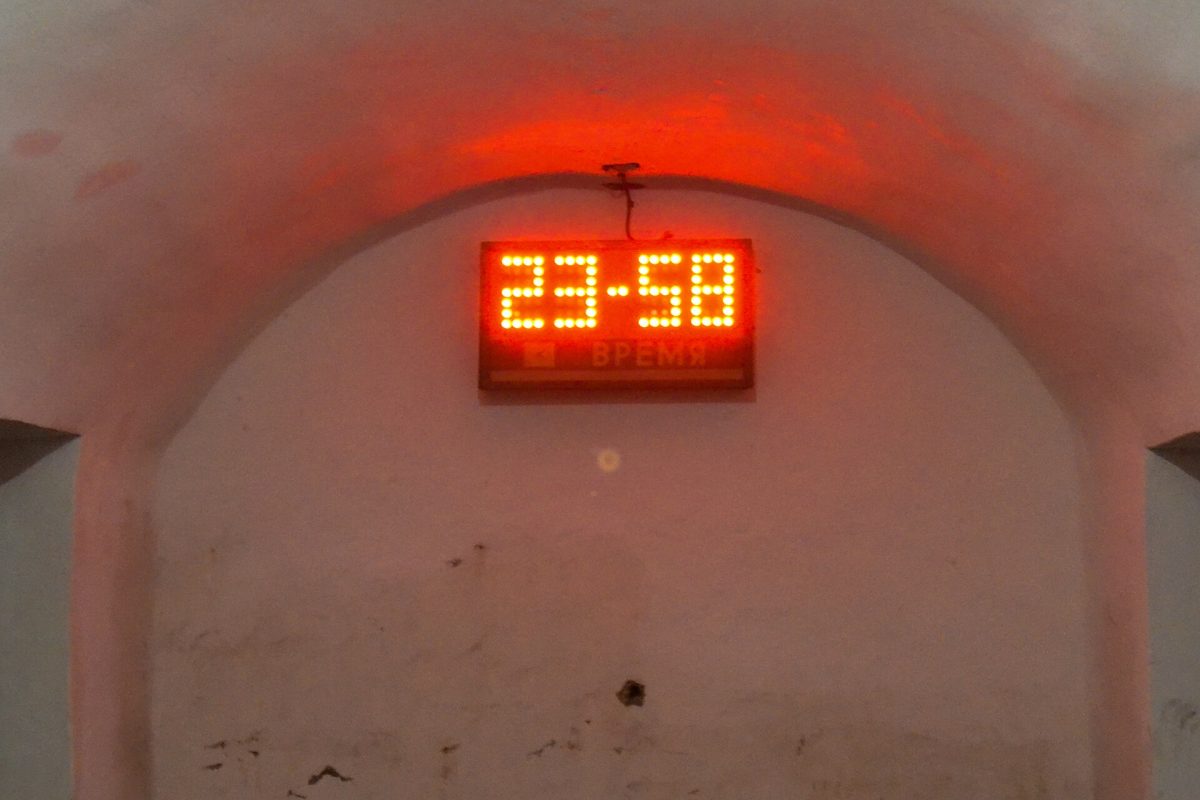
The Doomsday Clock was set closer to midnight than it’s ever been before on Jan. 27. The Doomsday Clock is a symbol created by the Bulletin of the Atomic Scientists in June 1947 to show how close humanity is to a worldwide disaster.
For nearly 80 years, scientists have used the clock to illustrate the severity of global dangers.
Each year in January, factors such as nuclear warfare, climate change, artificial intelligence and biological threats are assessed to determine how close the world is to zero, or midnight, on the clock.
While the clock can’t precisely predict existential threats, it is designed to show how man-made issues can bring the world closer to self-destruction.
“The Doomsday Clock is really a metaphor for the amount of danger that we’re in. But it’s also a call to action,” Alexandra Bell, president and CEO of the Bulletin, told University of Chicago News. “We have time left to fix the problems we ourselves have created.”
Throughout the past year, there have been numerous conflicts involving nuclear powers, such as the ongoing Russia-Ukraine war, the border conflict between India and Pakistan and the arms race between major world powers like China, Russia and the U.S.
The Doomsday clock was introduced in 1947, two years after the U.S. bombed Hiroshima and Nagasaki, and has since been reset 27 times.
The furthest the clock has ever been from midnight was 17 minutes in 1991 after the Cold War and the signing of the Strategic Arms Reduction Treaty.
The START treaty, which was extended for five years in 2021, expired on Feb. 5. Even so, the Doomsday Clock can move backward if world leaders choose to cooperate over conflict, as many of the risks are human made. With the treaty’s expiration comes an unstable nuclear landscape and the likelihood of a continued arms race among world powers.
Nuclear powers can agree to the terms of the expired treaty as has been done in the past, but so far no such agreements have been made, leaving both scientists and arms experts concerned about the future.
AI and new technology are developing rapidly, with AI spreading rapidly into areas such as health care, education, defense and business.
AI’s emissions and water consumption are also rapidly increasing. Alex de Vries-Gao, a PhD candidate at Vrije Universiteit Amsterdam, conducted a study to determine AI’s environmental impact, which cannot be determined solely by looking at the energy of data centers in general.
By separating AI emissions from general data center emissions, de Vries-Gao discovered that AI systems “consume between 312.5 billion liters and 764.6 billion liters of water,” which is more than the entire global bottled water industry uses and more water than people drink annually. Climate change is another major scientific concern.
There has been a rise in heat waves, droughts and floods recently, and all these extreme weather conditions are becoming more frequent and intense.
Scientists have explained that these conditions are largely due to global warming caused by greenhouse gas emissions, and most recently AI emissions.
Many experts argue that governments are not taking adequate action to slow the effects of climate change, which increases long-term risks for the public.
Because of this, they believe strong guidelines are needed to prevent harm moving forward.
While world leaders continue to fail to bridge divides, the Doomsday Clock stands at 85 seconds to midnight, a figurative reminder that if humanity continues down this path, these large-scale threats to global safety will become an inevitable reality.