
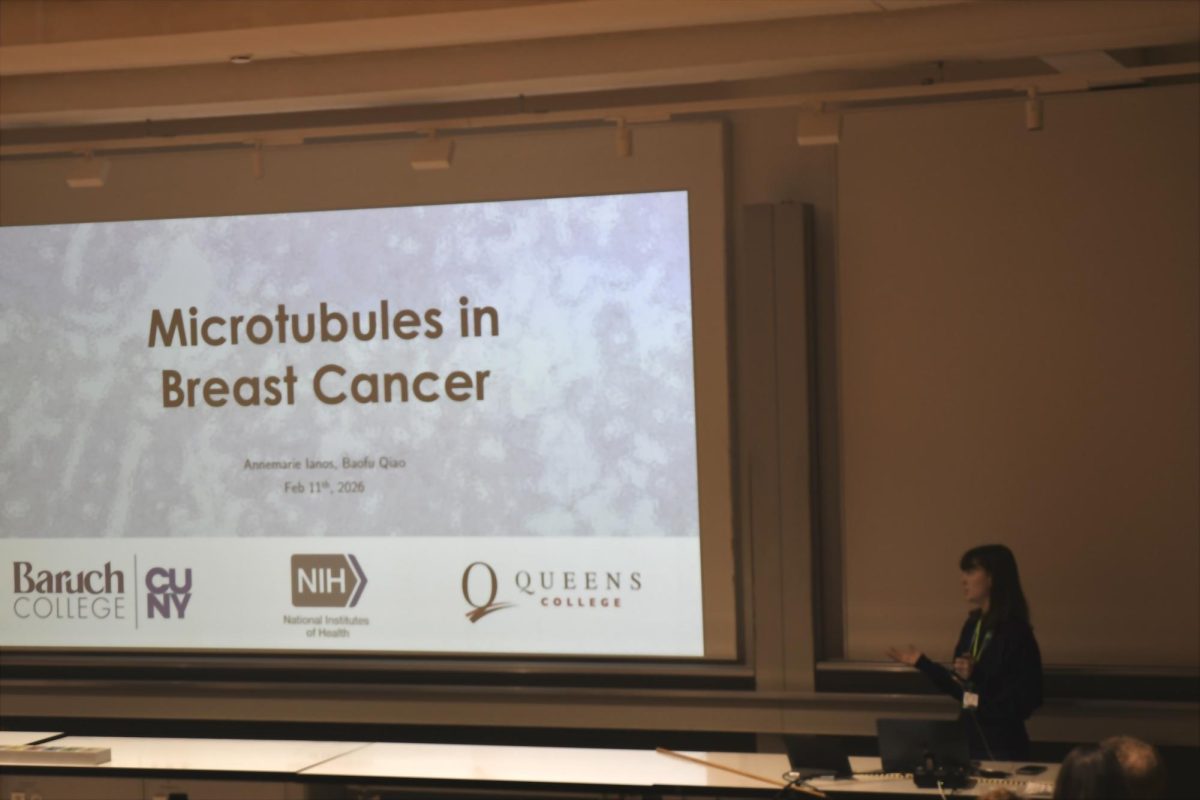
Annemarie Ianos is a senior at Baruch College majoring in biomedical sciences and pursuing research in computational chemistry with Assistant Professor Baofu Qiao. Recently, she presented her research projects at the Life Sciences Switzerland Annual Meeting, one of Switzerland’s leading conferences in biological sciences.
LS2 is a nonprofit organization that unites life sciences researchers across Switzerland.
Ianos presented her project on microtubules and breast cancer.
Microtubules are tiny structures inside of cells that help cells keep their shape and divide. Certain mutations may affect how cancer grows and spreads throughout the body, which are proliferation and metastasis, respectively.
“My research is mostly focused on microtubules and breast cancer,” Ianos told The Ticker. “We’re looking at different microtubule mutations that can lead to increased metastasis or proliferation in human breast cells.”
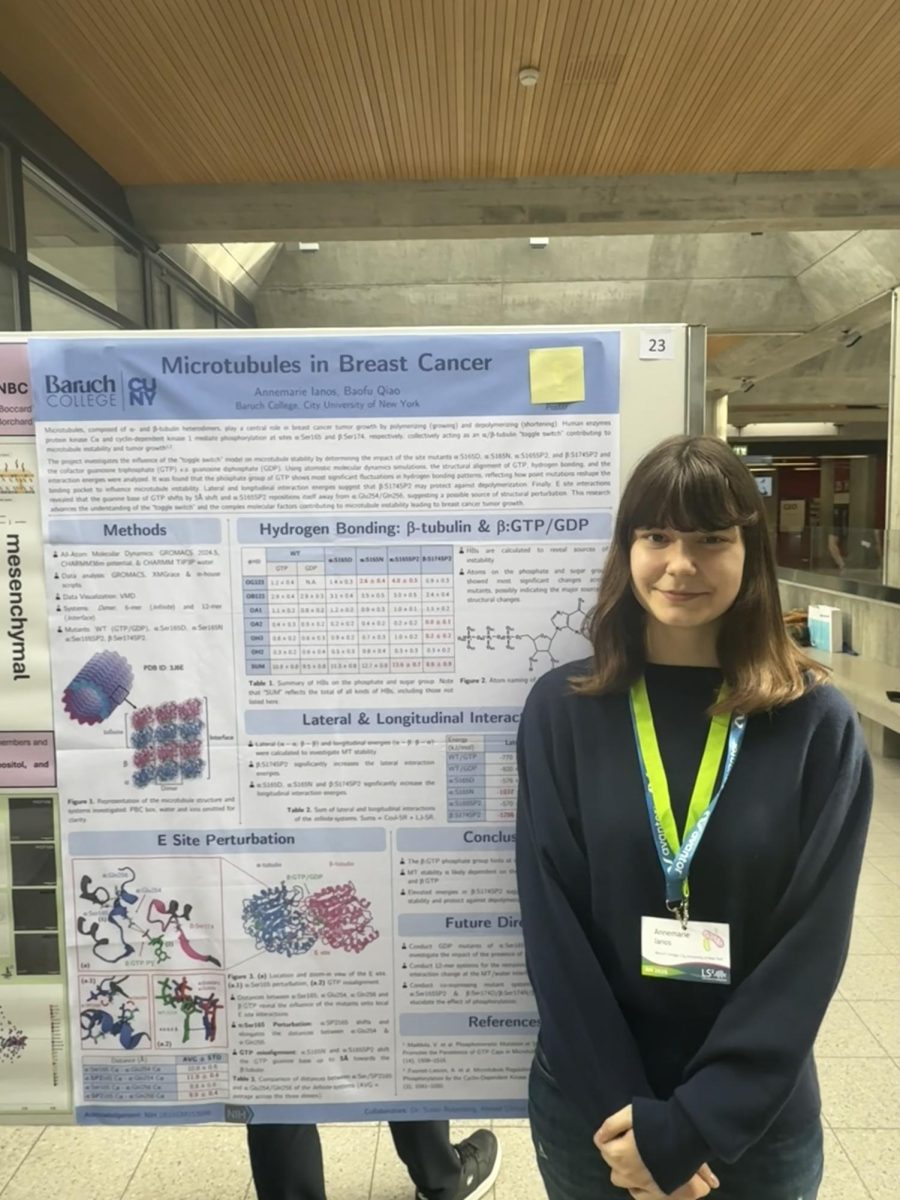
Ianos studied these mutations using molecular dynamics simulations, meaning she used a computer to model how tiny parts of a cell move over time.
Instead of only looking at cancer cells in a lab, she built a digital version of microtubules and watched how the atoms inside them shift and interact.
This helped her observe small changes not visible under a microscope and understand how certain mutations might affect how microtubules behave and affect the growth of cancer cells.
“We’re looking at the behavior of the atoms individually and also the global microtubule structure,” Ianos said. “This way, we can pinpoint which exact residues are giving this effect.”
She obtained protein structures from the Protein Data Bank, a global database of experimentally-solved molecular models. Her work is part of a larger collaboration. Experimental researchers study the mutations in-vitro and in-vivo in mouse models.
From there, she took those mutations and analyzed them computationally to understand what happens at the smallest level possible.
She said computational research is becoming increasingly important in biomedical science. The National Institutes of Health grant proposals now encourage research teams to include some computational work, reflecting the growing role of simulation and data-driven methods in modern research.
Simulations run at extremely small time scales and high precision, where they can take weeks or months to complete, thus generating large amounts of data.
She also noted that this process can raise concerns about noise in the data, making results more difficult to interpret and analyze clearly.
“You can never eliminate noise,” Ianos said. “At some point, the data reaches consistency, allowing us to decide that this amount of noise is acceptable.”
Before any simulation begins, the structure must first reach a stable state.
“You have to equilibrate the structure to let it reach its energy minima,” she said. “You’re not just putting the molecule in a box and letting it run.”
Advances in artificial intelligence also support her field. Tools like AlphaFold can predict protein structures and improvements in computing power benefit computational chemistry research.
Despite the challenges, Ianos said the research is worth it.
“I like having a hypothesis about what’s going to happen and then looking at the data to see if I was right or wrong,” she said. “That’s really fun.”
At first, she thought research would simply be lab work. Now, she shares her experience as encouragement for other students who may feel the same way.
“Research is more than just running experiments,” Ianos recalled.
“It came with life lessons. It came with mentorship. I got a lot of connections.”