
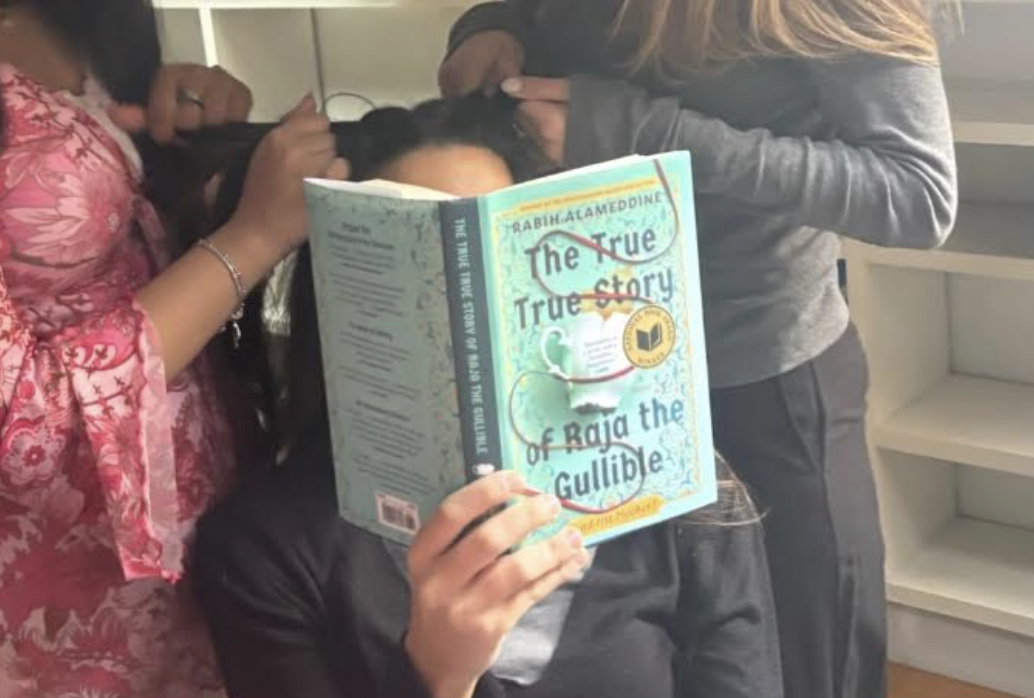
“The True True Story of Raja the Gullible (and His Mother)” by Rabih Alameddine is a novel about what it means to survive long enough to tell your own story, moving between personal memory and national catastrophe.
The story opens in 2023, where Raja lives with his mother and their two cats in a small apartment in Beirut, Lebanon. It begins when Raja received an offer to attend an all-expenses-paid writing residency in Virginia.
What initially appears to be hitting a set of sevens on a slot machine prompts Raja to reflect on the disasters of his past and the circumstances that make him eager to accept the opportunity. The novel is structured around four major crises in Raja’s life: the years leading up to the 1975 Lebanese Civil War, the COVID-19 pandemic, the dispossession of Lebanese people’s money during the banking collapse and the 2020 Beirut port explosion.
Throughout it all, the only two pillars that remain central are his mother and his register for Lebanon.
The novel reads like a memoir, with Raja narrating his life in a voice that is jumpy, digressive and irreverently funny — where coherence feels secondary to personality. The effect is disarming, especially because the word “gullible” demands a certain vigilance.
If Raja is gullible, then perhaps what he tells the readers is less about factual accuracy and more about what he once believed. This puts readers in a position to be cautious and attentive.
The novel’s paradox is that Raja’s gullibility is merely emotional permeability. What feels like a daily negotiation for dignity, constantly costing him his own boundaries, seems resolved by the end of the book. It’s not so much about what Raja says, but that he finally gets to do what he wants most: tell his story.
Raja’s childhood in Beirut is marked by comparison, particularly with his terribly mediocre brother, who is consistently favored over him. His effeminacy, once indulged, becomes a source of shame as he grows older. Despite excelling academically and building a career as a teacher, he remains deeply aware of how he is viewed.
This tension culminates in the novel’s most disturbing and formative scene: his captivity at the hands of his classmate and first sexual partner Boudi. Within captivity, Raja experiences a form of acceptance as he assumes a domestic role, performing femininity without ridicule.
However, this acceptance exists only within confinement and when he returns to the outside world, the shame returns with him.
“You could say a civil war that would last for fifteen years crumpled everything, but truly, it was the dress that did,” he said. “The fact that I reentered the world above wearing a simple summer dress and sneakers, and carrying a cat no less, was a devastation.”
Raja’s relationship with his mother is at the center of his story. He describes her as someone adept at drawing out stories from both him and his students, whom she often encountered at demonstrations in Beirut. She would use these encounters as opportunities to ask about Raja and share news about him, which seemed to be his main point of contention.
The novel parallels Raja’s relationship with his mother and his dynamic with his students, whom he affectionately refers to as his “brats.” These connections often overlap. In the final section, at his mother’s funeral, students from all his classes come to pay their respects. Although Raja tries to remain professional, he ultimately refers to them as his “babies,” a clear indication of his changed feelings and his mother’s enduring influence.
Other central women in the novel include his formidable, homophobic aunt Yasmeen, her lesbian daughter Nahed and Madame Taweel, whom his mother befriends during the electricity crisis and happens to conveniently lead a generator-stealing mafia ring.
Each became a pivotal figure in Raja’s life: Nahed offers him unexpected comfort; Madame Taweel’s presence, at first overbearing, eventually becomes familiar and convenient; Aunt Yasmeen, once the bane of his childhood, spends her final days in Raja’s apartment, succumbing to COVID-19.
Listening to her final conversations with imagined relatives, Raja witnesses the human need to narrate one’s life into coherence: “I was able to decipher snippets of the conversations she was having with her dead relatives. I understood that she spent most of the time justifying her life. Her past flinging accusations, her present attempting to explain.”
In the end, the residency that frames the novel feels incidental. What matters is the accumulation of stories that precede it: the humiliations he carries, the roles he performs and the people who remain with him long after they are gone.