
“Primate,” released Jan. 9, marks 18Hz Productions’ first feature film, distributed by Paramount. The company prides itself on “producing films that spark conversation, challenge conventions, and leave audiences thinking long after the credits roll.” Its partnership with Paramount focuses on developing “low-to-mid-budget mainstream horror films for both theatrical and streaming releases,” and “Primate” accomplishes this mission perfectly.
Directed by Johannes Roberts, the film stars Johnny Sequoyah, Jessica Alexander and Academy Award-Winning Actor Troy Kotsur. The story centers on Lucy Pinborough, a young college student returning to her home in Hawaii after years away.
Her recently deceased mother had kept a pet chimpanzee named Ben as a subject for her linguistics research. The plot follows Lucy, her sister Erin and their friends Kate, Hannah, Nick, along with a few people they meet at the airport.
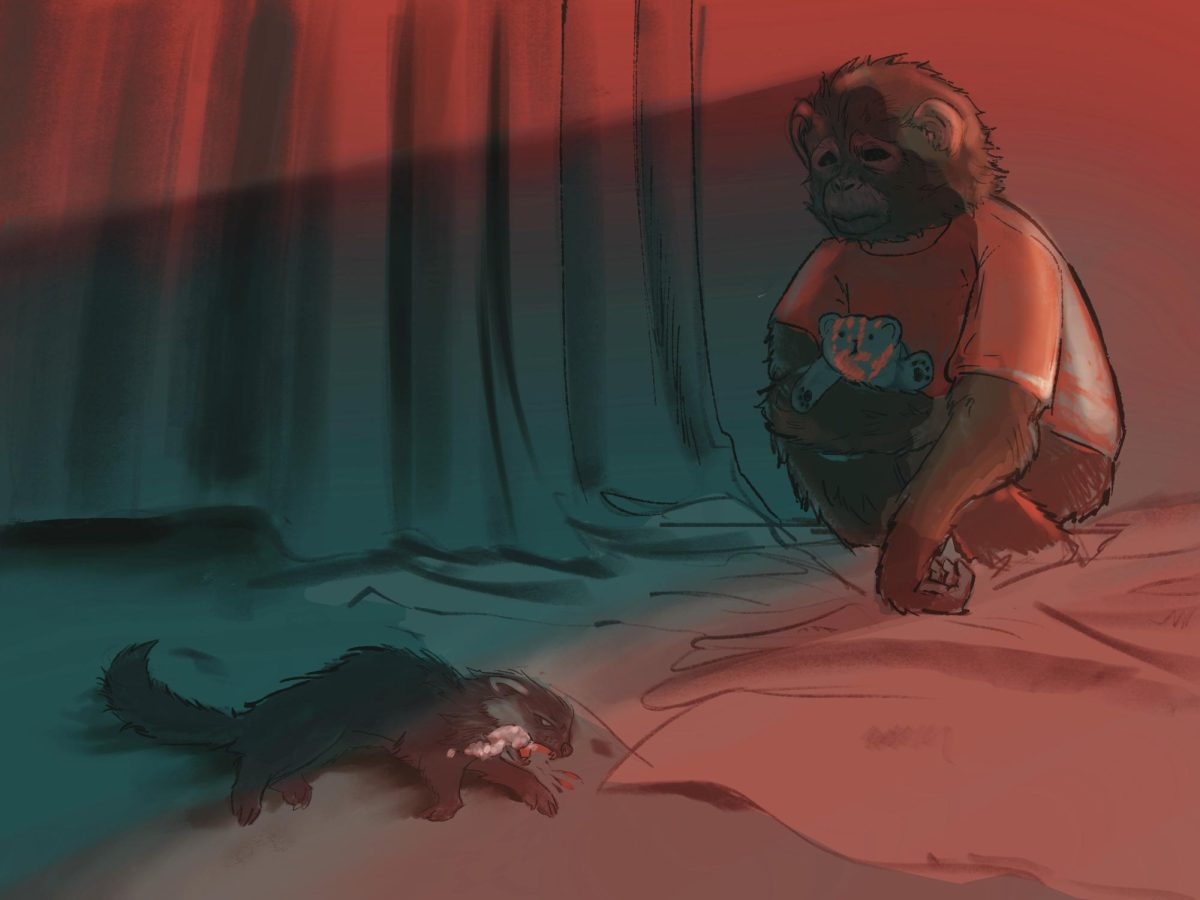
Ben, a once calm, sweet and docile chimpanzee, contracts rabies and transforms into a brutally violent threat. What follows is a visceral rampage — gory, sudden and at times agonizingly slow. The film doesn’t hold back and the deaths throughout vary from startling to stomach‑churning.
This is absolutely the kind of movie that has viewers clenching their jaws, covering half their eyes and yelling at the characters when they’re about to do something blatantly foolish.
At moments, the decisions feel too dumb, clearly engineered to prolong the horror; viewers may find themselves thinking, “I would survive this so easily.” Then again, no one truly knows how they’d react when facing a rabid, murderous primate.
One of the most impressive aspects of the production is that Ben was not created using CGI. Instead, the chimpanzee was brought to life using a fully practical approach with a performer in a suit. Combined with the film’s dedication to gore, blood, bone and all sorts of fleshy chaos, the R rating is undeniably deserved.
Squeamish movie-goers may not find this a good watch. With a tight 90-minute runtime and a $21 million budget, the film wastes no time.
The early scenes of friends hanging by the pool, drinking, playing games and listening to music are immediately relatable and make the horror hit harder once everything collapses. Hannah, who is only a loose acquaintance of Lucy’s through Kate, stands out as the most sensible character, immediately recognizing that Ben should be put down once he becomes violent.
The ending wraps up the core threat with clear survivors and victims, but the characters’ emotional responses afterward feel oddly muted and unrealistic. The final moment, where a police officer toys with Ben’s voice pad, repeatedly triggering the phrase “Lucy bad” — a phrase that Ben used throughout the film — raises questions. Why end on that note? What is the purpose of calling back to the trauma that just unfolded? It seems like either a hint at something larger or simply an attempt at an ambiguous, stylistic flourish for 18Hz’s debut.
Overall, the film is fun, shocking and effective for its budget and runtime. The audience’s reactions lined up almost perfectly, proof that the movie reliably provokes the same instincts and frustrations in its audience.