
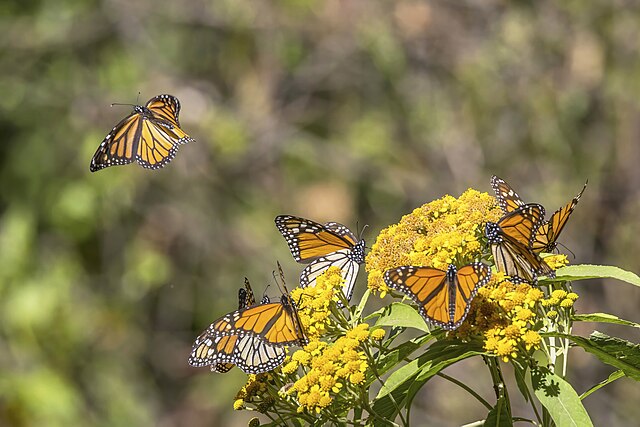
Danaus plexippus, also known as the monarch butterfly, is characterised by its orange inner wings, black outer linings and large size. The black outer lining serves the vital purpose of warning would-be predators of the insects’ bad taste.
Like all other species of butterfly, monarchs start as caterpillars and, unlike their adult form, their immature form is black, yellow, green and white in the shape of vertical stripes. They are native to the Americas and Texas is an important place in their travels to and from Mexico.
A subspecies — subspecies D — does not migrate and lives near the Cayman Islands. In rare instances, the butterfly has been found in Hawaii, Australia and India. Christine Merlin, a chronobiologist at Texas A&M University, reversed genetics in the butterflies to control for specific genes to better understand how their presence or absence impacts their navigation.
Merlin’s discovery could help study other migratory insects. Some of the many migratory insects that might benefit from this research include the common green darner and the blue dasher.
Merlin was able to reveal what sensors allowed monarchs to detect the Earth’s magnetic field. Her 2021 nature communications study isolated a specific gene, CRY1, as being a requirement for the magnetic response. However, CRY1 is not the only factor in a monarch butterfly’s ability to sense the magnetic field; eyes and antennae also play a role. Under Merlin’s lab, researcher Kayla Goforth used CRISPR gene editing technology to test which genes, when removed, affect the insect’s orientation using magnetic fields. CRISPR gene editing goes beyond understanding the migrations of butterflies; the technology can be used to control pests and eliminate malaria through gene drives.
Texas A&M is conducting research on monarch butterflies because the population has declined by 80% since the 1990s. The decline is so significant that the U.S Fish and Wildlife Service might put them on the threatened species list.
Monarchs are pollinators that support the Texas food system, which is relevant as Texas ranks fourth in U.S. agricultural production. Without pollinators like monarchs more than money would be lost and food shortages would endanger livelihoods across the United States. To save the monarch butterfly, identifying what threatens them and then making changes is the key; ensuring there is a place for pollinators along Texas highways is a starting point.
Native plants along the roadside allow humans and monarch butterflies to live alongside each other while reducing road mortality for the butterflies.
Monarchs not only serve local economies by keeping agriculture fruitful through pollination but also serve as symbols for people across cultures. The Smithsonian Center for Folklife and Cultural Heritage describes the insects as being winged messengers. Indigenous Mexicans, such as the Purépecha of Michoacán and the Mazahua of Estado de México, believe the monarchs to be carriers of their ancestors’ souls; the butterflies represent the dead still living for them.