

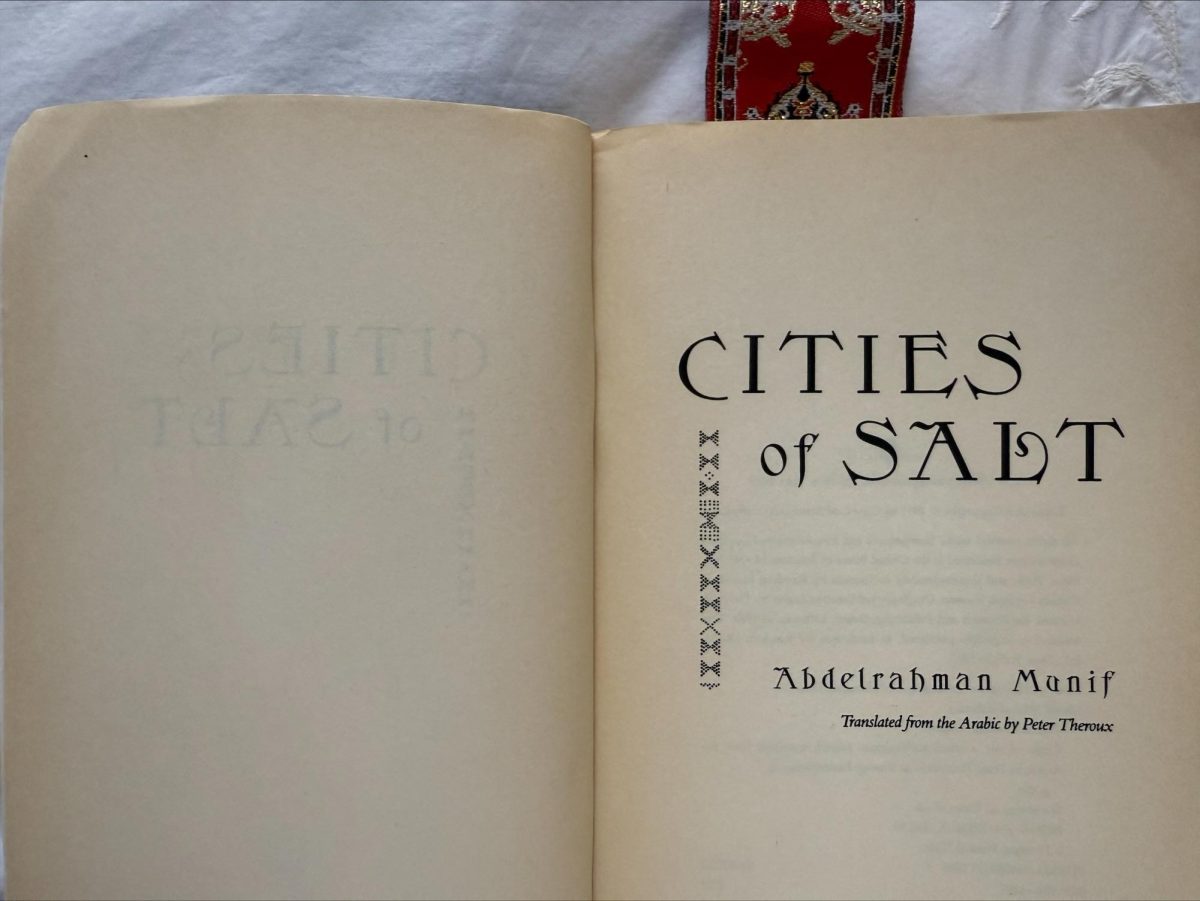
Abdelrahman Munif’s “Cities of Salt” is a historical petrofiction novel that explores the discovery of oil and the effects on people when the ground beneath them is abruptly stripped away. Although it takes place in fictional Gulf cities in the early 20th century, its themes apply to any community facing displacement or any society dismantled in “the name of progress.”
Modernity presents itself as liberation, but instead manifests as a shift from one form of domination to another, while prosperity for locals remains out of reach — a reality underscored by Munif’s loss of Saudi citizenship. His punishment reflects the very dynamics he critiques: a state eager to adopt petro-modernity while silencing those who challenge the political compromises and cultural erasures that enable it.
The first part of the book details the arrival of Americans in Al-Wadi, a Bedouin town whose destruction marks the novel’s first major transformation. Munif details the sensory violence of this intrusion. The “big scary machines” roar and shake the earth, flatten groves and undo an entire community. The environmental devastation is explicit, but also serves as a metaphor. These machines tear through both the land and spirit that once held the community together.
The novel’s true brilliance lies in its characters. Munif constructs them as interpretive frames for the transformations engulfing their world.
Ibn Rashed embodies the disillusioned Arab who first cooperates with foreigners, only to be too late to recognize the costs. Hammad represents the young man who instinctively resists the new order and seeks escape. Fawaz is the opportunist who adapts with ease. The Emir stands as the clearest indictment of Munif’s political critique: a ruler whose complicity enables every form of exploitation that follows.
Miteb al-Hathal and Umm Khosh, though vastly different, each symbolize resistance rooted in intuition.
Miteb al-Hathal is revered as a guiding figure and is initially mocked for his warnings about the incoming oil companies. Umm Khosh, a mother derided for hoping her lost son will return from travel, clings to faith. When both are absent just before the expulsion begins, their community, which once dismissed them, feels an unsettling void and realizes how much they depended on Miteb al-Hathal’s foresight and Umm Khosh’s hope.
Miteb al-Hathal’s stories reemerge when workers face dire conditions and collective suffering inspires the ideas he once voiced. From the beginning, he served as the sole voice of resistance, and in his absence, he became the spirit. His legend reminds the community that dignity once existed and can be reclaimed.
The expulsion section illustrates the transformation each of the characters endure. Young men are forced to shoulder heavy responsibilities, and at the same time, the myth of women’s futility is deconstructed as they take on leading roles to ensure their families’ survival.
The book details the nights leading up to expulsion, describing psychological warfare and indirect terrorism that, though subtle enough to be dismissed by outsiders, remains profoundly terrifying for those experiencing it.
It portrays anger and the weariness Arabs feel from fearing Americans, whom they see as a fundamental threat because of their godlessness. Faith endures throughout the novel and serves as the humility that steadies the characters through upheaval, loss and forced displacement.
As the book progresses, the setting shifts to Harran, a city built for oil extraction. Harran houses both Arabs and Americans. As more Americans arrive, the Arabs describe what living with them is like and how their way of life tests their faith.
The city grows from temporary camps to a rigid, segregated settlement in a landlocked factory state. Conditions deteriorate rapidly with withheld wages, unexplained dismissals, suffocating housing and daily humiliation by foreign supervisors who see Arabs as interchangeable labor.
The climax culminates when the workers refuse to move and the foreign administrators begin to panic. The local authorities respond predictably with force, revealing how deeply the state has aligned itself with American interests.
The novel ends by showing what has been irrevocably altered. The strike is crushed, the workers become scattered and Harran resumes its routines. The illusion of progress finally collapses.
What remains is a city propped up by coercion and denial, a modernity built on erasing the people whose labor sustains it.
The book ends just as the community begins to see that their suffering is not incidental to this new world but foundational to it. There is no resolution. “Cities of Salt” offers not catharsis but warning: any city built on state violence and constructed without its people stands on the edge of dissolution, just like salt in water.