
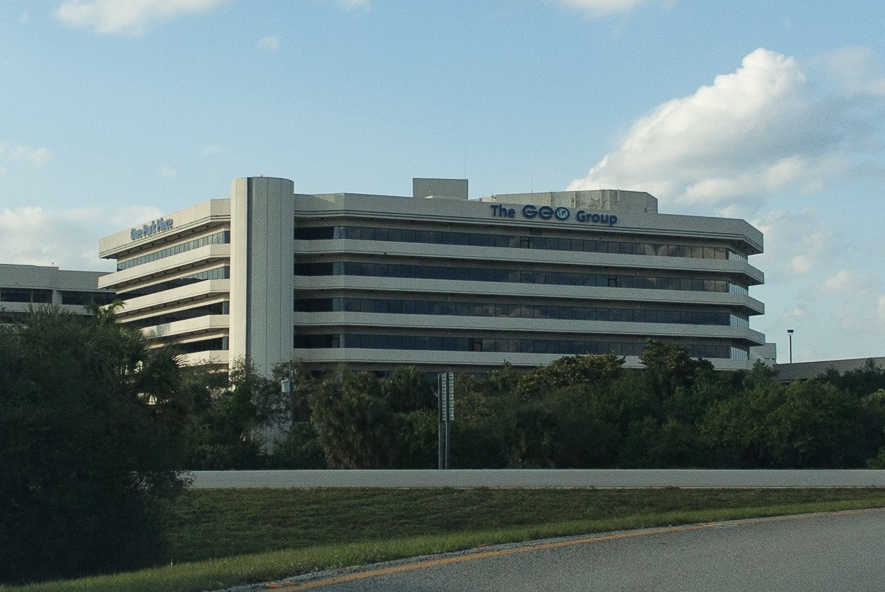
Jaen Mawer Enciso Guzman, a Venezuelan migrant, was arrested by Immigration and Customs Enforcement agents after his scheduled immigration hearing in Manhattan on June 4. Guzman, and the several other people detained that day, were taken to an ICE prison staffed by the employees of the GEO Group, a for-profit, private prison company that has been contracted by ICE to run detention facilities. GEO Group was founded in 1984, when the ‘War on Drugs’ led to an incarceration boom, building its early money from America’s first private prisons.
Now, the company is seeing its private prison business soar under the Trump administration’s efforts of detaining undocumented immigrants.
In 2017, President Donald Trump’s first immigration crackdown presented the company with an unprecedented opportunity to capitalize on ICE contracting.
“I do think we can do a lot of privatizations, and private prisons. It seems to work a lot better,” Trump said in an MSNBC town hall in 2017.
Republicans have historically seen private prisons as a way to reduce government spending and jail overcrowding.
This year, the company anticipates $2.6 billion in total revenue, with BlackRock Inc., Vanguard Group and State Street Corp. holding almost $1 billion in GEO Group stock. The U.S. leads the world in private prison profits.
As detainees await immigration judges decisions, 90% of all ICE detainees today are held in private prisons, and that number could increase.
“We can expect the number of facilities to increase with the $45 billion allocated in the [One] Big Beautiful Bill although we should also be watching the increased use of local jails where we’ve already seen a 600% increase in programs like the 287(g) program since the beginning of the year,” Felicia Arriaga, a Baruch College assistant professor researching immigration, said.
These detention centers now account for 42.7% of the GEO Group’s revenue.
Furthermore, Trump’s recent signing of the Laken Riley Act requires ICE to detain all non-citizens charged with low-level offenses.
“The upside potential from all these opportunities could represent as much as $800 million to $1 billion in incremental annualized revenues,” GEO Group CEO George Zoley said.
Despite a $23 million labor trafficking settlement in Washington, the GEO Group has denied allegations of indefinite detentions where migrants are held with insufficient medical care, food and water.
“We do not take a position on, or advocate for or against, criminal justice, sentencing, immigration enforcement or detention policies,” the GEO Group told The Washington Post.
Maurizio Guerrero, an investigative journalist and doctoral candidate at the CUNY Graduate Center, told The Ticker, “I’ve received many statements from GEO Group, and it feels like they are operating in a parallel reality.
“I don’t know any GEO Group executive that has been punished because of the often-preventable deaths in their detention facilities.”
With 57,000 people now held in ICE detention centers, these prisons have raised ethical concerns.
“The size of the private prison industry incentivizes these companies to maintain the immigration crisis through lobbying. They need bodies occupying their facilities in order to produce profit,” Mathew Sarmiento, a Mellon Mays fellow studying immigration at Queens College, said in an interview with The Ticker.
Despite the moral ambiguity of private prisons, the federal government has been unable to maintain adequate detention capacity without the GEO Group’s services.
“They have a lot of leeway in mistreating people, because the government is on their side.”