

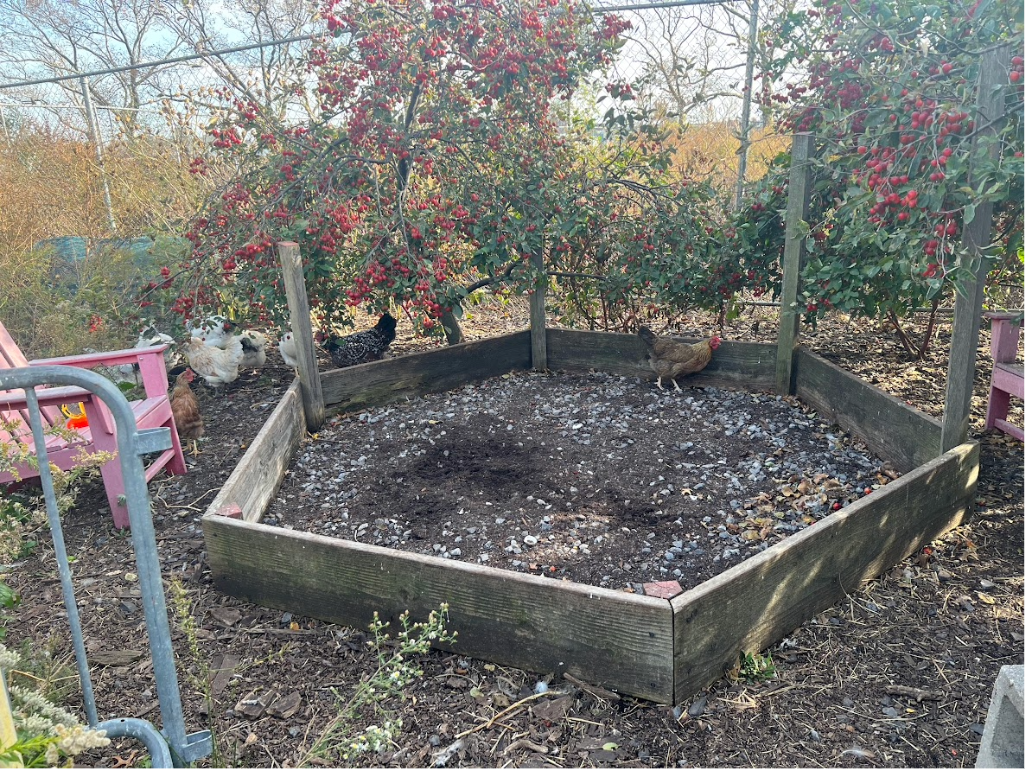
Baruch College organized a site visit to Governors Island on Nov. 7, in collaboration with the Office of Student Life, where professors and students visited Earth Matter NY to learn how true circular sustainability functions.
The site demonstrated that composting is not just an idea, but also a system that has rules, measurements and biological forces.
Earth Matter staff explained the science behind composting.
The process begins with bacteria, which starts breaking down piled fresh organic scraps and generates heat as a result.
If the pile is managed well, the temperature can reach up to 160 degrees Fahrenheit. When that level of heat is held for about two weeks, pathogens are destroyed.
After the pile cools, fungi take over and continue the breakdown of tougher material, such as wood chips. The conversion from bacteria to fungi is the natural process that transforms scraps into cool, finished soil.
Earth Matter also showed the logistical side that most people overlook.
They receive food scraps from a soup kitchen on the Lower East Side and drop-off sites in Manhattan.
Loads get weighed, materials get layered and the carbon-to-nitrogen balance is intentionally maintained.
They accept fruit peels, vegetable scraps, meat and bones. This showed students that composting is not limited by science, but by the choices cities make in how they manage organic waste.
Students also participated in hands-on activities to understand how physical the work is.
They helped with soil bagging and stacking, and some students collected sand at the site. Some students were able to take fresh produce from the farm, which included fruits such as oranges and crab apples.
“My experience with Earth Matter at Governors Island was not only fun but also insightful. We helped pack finished compost into 42-pound bags of this rich fertilizer, which would later be shipped to community gardens across the city,” Eric Gonzalez, a senior majoring in marketing, said.
The purpose of these activities were to see that composting is real work. “Composting is not just a theory, it is physical work. You must move material, measure it and monitor how it breaks down over time,” Chishana Rattan, a junior majoring in journalism, said.
There is also a farm next to the compost site that utilizes soil created from food scraps to grow new crops on the island.
Volunteers can take some produce home, while the rest get donated to community kitchens.
At the end of the growing season, the plant material is returned to the compost piles. Organic matter does not exit the system as garbage, but instead re-enters as input.
They measure temperature, manage airflow, track weight and monitor time.
This is the difference between talking about sustainability and actually engaging in it.
Earth Matter showed that waste is not automatic, but the result of how systems are designed.
When a system is built correctly, waste material can be reused.
Categories:
Baruch visits Earth Matter NY on Governors Island
November 17, 2025
More to Discover

About the Contributor
Manish Kumar, Science & Technology Editor
Manish Kumar is the Science & Technology Editor of The Ticker.